Going North

II: Going North
Driving North.
On day three we left Bucharest to go north. There were the the six of us, our luggage, and Cristian, who was the guide/driver. Even in the early morning the traffic was heavy, but outside the city there was not much traffic on the highways. Outside Bucharest the fields on both sides were lying fallow, because the corn and wheat had already been harvested. Many of these fields may not even be cultivated next year, because the boom has resulted in a lot of new construction outside the city proper. Well, there may be a glitch with the now expected downturn in the world’s economy.
Curtea de Arges.
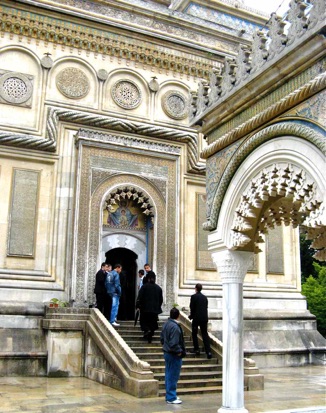
This former capital of Wallachia is one of the oldest cities in Romania, some 100 miles north of Bucharest. Our destination was the church of the Monastery of Curtea de Arges, a magically beautiful episcopal church built in marble and mosaics brought from Constantinople.
right: The entrance to the Church in Curtea de Arges.
It was constructed in 1512-1521 with Moorish inlays, whorls, rosettes and fancy trimmings, and Arabian, Persian, and Georgian motifs intertwined with each other. The frescoes on the walls are breathtaking in their beauty. And especially impressive is the onyx iconostasis1 and the twelve columns inside the building with floral ornaments representing the 12 apostles.
In this church are also the tombs of the first Romanian kings and queens, Carol I and his very accomplished queen Elisabeta, and across them Ferdinand and Maria. These people ruled over Romania when they were alive. Now each only command a narrow piece of soil, not more than 2 meters long.
An iconostatis is a wall of icons and religious paintings, usually in the back of the church, separating the nave from the sanctuary.
The Ballad of Manole
There is a well-known, hauntingly sad ballad about this church. The Ballad of Manole tells that one day the Black Prince, a very wealthy and religious Wallachian prince, asked nine masons and their great master builder, Manole, whether they could build a church more beautiful than anyone may have seen before. Yes, Manole and the masons replied. And so, on this place the masons started to create their work of art. But whatever walls they would erect during the day, these would crumble during the night. This kept on for a week until Manole received the message in a vivid dream that all their labors would be in vain until they would immure within the rising walls a beautiful young wife.
Manole tells the dream to the masons and they agreed that the first wife who visited them would be sacrificed in order to have their work done. They swore a pact not to tell their wives. But all nine masons reneged and only honest Manole kept silent. And so it happened that Manole's wife showed up to bring her husband his lunch, since nobody else wanted to take the lunch to their husbands. Manole saw her coming and implored the Heavens to prevent her from coming to the site. Heavens complied, sending high winds and fearful rains to swell the waters of the streams. But these did not impede her progress. She was a dutiful wife and forged through all the elements to bring her husband his lunch. In despair Manole asked the Lord to send a deep and dense darkness. She stumbled and scattered the food, but she went back home to prepare some more. And she came back.
Broken-hearted, Manole had to keep his vow. At first she thought it was just play, but as the work progressed and she understood, she complained softly that it was so cold and lonely in that tomb. What would happen to their child she left at home. Who will nurse it, she begs. “The fairies will see to it that she gets nursed”. Who will bathe it?. “The rain will fall and bathe it”. Who will sway the cradle? “The wind will blow gently and will sway it to sleep” 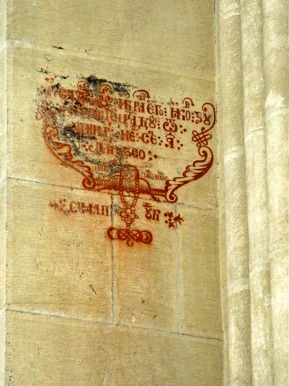
left: Under this sign is the place where the wife of the master builder Manole was immured to ensure that the walls of the church would stay upright
The place where she is immured is still indicated by a sign between two walls of the southern front side of the church. Manole was heartbroken, but this is how the church could be finished. The prince was pleased to find that it was as beautiful as it could be.
And then the prince asked the masons. Can you build me another church, which is even more beautiful than this one. Yes, said the masons in unison. But the prince did not want them to build another church that could match his own. So he ordered the scaffolding removed, which left Manole and his nine companions stranded on the roof to die of starvation.
Manole made himself a pair of wings from shingles. What follows is from Paul Brewster.
The spring is still there and people, unknowing of the grief of Manole, come by and toss coins in the water.
The Cozia Monastery.
On our way to Sibiu, we stopped at Cozia Monastery, which was built in 1386. It is a small church but the Byzantine frescoes are worth a visit. This monastery was built by Mircea cel Batrin, (1386 - 1814), prince of Wallachia, who is also entombed in this church. On the wall is a well-preserved fresco showing him and his son Michael offering the church to the Virgin Mary and to the baby Christ. There is a similar picture in southwestern entrance of the Aya Sophia showing emperor Justinian I offering a model of the Aya Sophia to the Virgin Mary and to the baby Christ.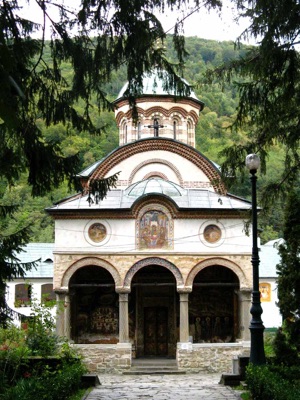
left: The front of the small and beautiful Cozia Monastery church.
Prince Mircea died in 1418, and his son Michael succeeded him. But only two years later Michael was killed in a border skirmish. So the throne went to Michael’s half-brother Vlad II. Vlad II was later honored by being induced in the order of the Dragon, and so he added Dracul (dragon) to his name. He became Vlad II Dracul and his son was named Vlad III Dracula, or little dragon. There is more on Vlad Dracula later in this journal.
.
right: Fresco showing prince Mircea and his son Michael offering this church at the Cozia Mnastery to Jesus and Mary.
Sibiu.
Sibiu is also known as Hermannstadt in German, Nagyszeben in Hungarian, and other less easily pronounceable names in Serbian and Yiddish. With a population of 175,000 it is one of the largest cities in Transylvania, and it has been designated, together with Luxembourg, as the European Cultural Capitals for 2007. Tourists to this town can now brag to their neighbors of having been immersed in European culture.
On a historical note, Hermannstadt was one of the seven walled citadels of the Saxons in Transylvania. The other six are Bistrita (Bistritz), Brasov (Kronstadt), Cluj (Klausenburg), Medias (Mediasch), Sebes (Mühlbach), and Sighisoara (Schässburg)
The center of the town, which is the oldest part of the city, is of course the most interesting. It consists of the Upper Town and the Lower Town. The lower town is not that interesting any more because of industrial development and modern urban planning. Most of the exterior fortifications have also disappeared.
The upper town, on the other hand, is where the richer people lived, and which has been best preserved and renovated. There are many nice buildings, palaces, churches, museums, lots of pedestrian only streets and squares, shops and restaurants, and in the summer many tourists come here to sit in one of the outdoor cafes on these streets to watch life go by.
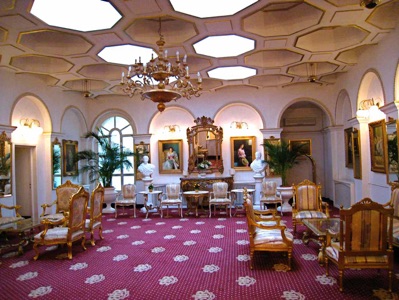
left: Foyer of the Roman Emperor Hotel.
Cristian had managed to get reservations for us in the 4 * Roman Emperor hotel, which is right in the middle of the Upper Town, half a block away from the Large Square, the historic center of the town. Their rooms were OK, but certainly not as nice as we had expected from their lovely entrance foyer.
The next day we walked around this eminently walkable city enjoying the sights; it is a place where we could easily have stayed an additional day or two to enjoy the surroundings. The large square was first mentioned as early as 1411 as a corn market. The most impressive monument there is the very baroque Brukenthal Palace, now a museum. In the past, some 24 powerful guilds dominated the town, and the still standing towers in the fortification bear the names of the guilds, who were responsible for the upkeep and the defense of these bastions.
To get to the Small Square we walked over the Liars Bridge, the first cast-iron bridge in Romania. A presumed origin of its name is that on this bridge lovers would say goodbye after their trysts, vowing eternal love and fidelity to each other. Our next stop was the cathedral, now an Evangelical Church. It is an impressive structure, built in 1520. In it is a gigantic fresco, almost 30’ high, showing the Crucifixion and other religious scenes with the people shown in Renaissance garb.. The painting was completed in 1445 and the colors are still brilliant. The church also has a huge organ; with 8000 pipes, no less. I had to take their word for it, I didn’t bother to count.
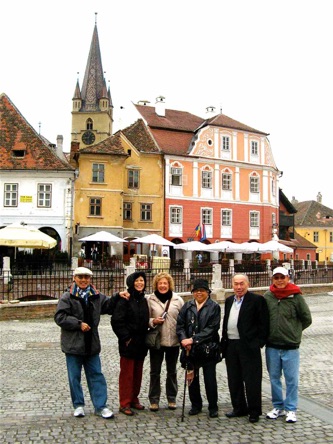
right: The six of us in the Small Square of Sibiu.
The baptismal font was cast from the iron of Turkish cannons left behind after one of their forays on the city and on the top of a wall, a Turkish cannonball is mounted to remind the people of these hazardous times. What I particularly like of this church is the life-sized sculpture of a gentleman at the exit, offering his hand, which you can shake. As did thousands before us over the centuries.
To reduce wear, most gravestones inside the church have been removed from the floor and are now displayed in a separate hallway. One of them was of Michna the Bad, a son of Vlad Tepes, the man also known as Dracula. Another one shows a laughing skull, with the inscription: “Today Me; Tomorrow You”. Very apt.
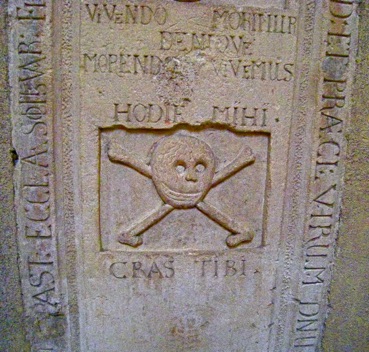
left: Gravestone with the text: “Hodie Mihi, Cras Tibi”, or “Today Me, Tomorrow You”
Our last stop was the Orthodox Cathedral, built in 1902 - 1906. It is an unusual church because it was built in a similar style as the Aya Sophia in Istanbul. It is the second largest Orthodox cathedral in Romania and it features a huge golden chandelier and neo-Byzantine decorations.
The Glass Icon Museum
From Sibiu it was a short 20 miles to Sibiel, a small hamlet where the Glass Icon Museum is located. This museum was started by a local priest and it now has some 450 pieces of peasant art. The motifs are almost all religious. These icons emerged as a result of social and political forces during that period. The Romanian people, although numerically in the majority, were living in strict subjugation to the Hungarians and Germans --who were either Roman Catholic or Protestants-- of the Hapsburg empire. One of their most effective methods to maintain their Orthodox identity was painting these religious icons. The paintings are all made on the back of glass panes, so the final drawing is shown in the reverse mode. Many of the older paintings were made by illiterate peasants.
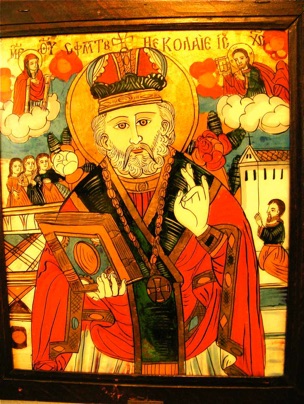
right: The artist forgot that the finished piece would be the mirror image of his work. So in this piece, Archbishop Nikolai is seen giving the blessing with his left hand. In the top right is Jesus Christ; in the top left is Maria.
The German word Hinterglasmalerei describes this technique best. The colors are made from natural materials. White was made from lime, yellow from yellow mud, red from salts of lead and copper, and blue from cobalt salts. The older paintings, from the 1700’s were primitive, where the figures were flat. But over the centuries the paintings became more and more sophisticated, and by the middle of the 19th century, the figures became more advanced with real facial expressions, even in the thumbnail sized drawings.
On our way to Alba Iulia, we stopped in a little village at a clean local restaurant for lunch. A big bowl of hearty soup to start, then two large platters with grilled meats and sausages, with polenta and french fries for starch. Dessert afterwards. A glass of beer with the meal, if so desired. If you wanted something special to eat in Romania, these platters of grilled meats and sausages are standard fare. The total bill for the 7 of us was $34. It would cost 2-3 times as much in the large cities.
Alba Iulia
When the Hapsburg empire collapsed, Transylvania broke away and in a plebiscite in 1918, tens of thousands of Romanians gathered here to vote for joining the Romanian kingdom. The main attraction of the town is the Unification Cathedral, a Romanian Orthodox cathedral, which was hastily built to commemorate this event. In 1922 king Ferdinand I and his wife Marie were crowned in this church. When we were there, it was a Saturday in September, and we saw at least 4 bridal parties in and around the church.
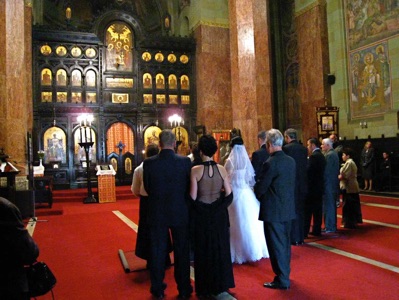
left: A wedding ceremony in the interior of the lavishly decorated Unification Church.
It may be a happy occasion for bride and bridegroom, but it seems they believe it was bad luck to be seen together with the other bridal parties. Or maybe the brides just didn’t want their bridegrooms to see the other dolled-up women just in case they might change their minds before they were securely hitched.
Close to the Church is a star-shaped Vauban1 fortress, partially restored for the tourists industry. There was also a section of a Roman wall dating to 106 AD, which was part of a Roman camp to protect the rich gold mines not too far away. They call this area the route of the Three Fortresses, but we were not able to determine where the third fortress was. Maybe it was just to lure the tourists this way.
1 The Marquis de Vauban, 1633-1707, was a marshal of France and the foremost military engineer of his age, famed for his skill in designing fortifications and also for breaking into them
Cluy
We continued north to Cluy, where Cristian had booked us in the Belvedere Hotel, a nice hotel on the top of a hill with a nice view of the town below. Guess what; another wedding in the hotel, and their restaurant was completely reserved for the party. We considered sneaking in to join the party; but our Romanian would have given us away. Cristian managed to get us a small table in an adjacent room, where we were served the same meal the wedding guests were given. Yes, we did have to pay for the food. Shucks.
The next morning we drove downhill to visit the city center and the 14th century St. Michaels cathedral. It was cold, a few degrees above freezing. People were just setting up stuff for the Sunday market behind the church, where bought a passel of nicely decorated Easter eggs for around $2.50 each.
Not as expensive as the Faberge variety and also not as attractive to make a maiden swoon. But good enough to add to our ever-expanding collection of dust-catchers from places all over the world.
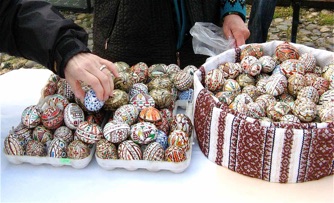
right: Hand-decorated eggs in market of Cluy
Or, we could have purchased a nice copper still to make homemade spirits. The man wanted €2000 for the big unit on the left, and we wonder what the US Customs would say if we lugged it into the USA.
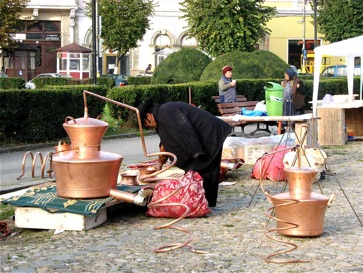
left: Copper stills to make your own award-winning Liquer.
The province of Bucovina.
We kept driving north, into the province of Bucovina, passing a city with the unusual name of Beclean. Which is better than be called Bedirty, I suppose. But Beclean is a very apt name for the area. The inner cities in this area are clean. People are actually picking up their trash and sweeping the streets in front of their houses.
It was Sunday, and everybody seems to be going to church. People here are 90 % orthodox and very religious. You drive by a community of maybe 30,000 inhabitants, and you will see at least 4 churches and a fifth one being built. A village with maybe 50-100 houses may have as many as 3 churches. That morning we saw many churches overflowing with churchgoers. People dressed in their Sunday best were standing outside the churches following the service.
Here, in the province of Bucovina, the houses are different. Every homeowner takes pride to make his house look special; by a special roof scheme, intricate carvings and designs on the external walls or on the doors and windows. There are often some other embellishment. Some of the houses are painted in strong, garish, eye-catching colors, maybe just to make a point. Or maybe because that particular paint was on sale that day. It does elicit a smile as you drive by.
As we drove up further north, we passed through the Borgo Pass. We stopped for lunch at Dracula’s Castle, a hotel at the top of the pass. The place did not have anything to do with Dracula, except to lure the unsuspecting tourist into their funereal feeling dining rooms with stone walls, high ceiling, and small high windows. But they did install a fake crypt dedicated to Dracula somewhere, but even for us that was too touristy.
We finally arrived in Gura Humorului, the area where the famous painted monasteries of Romania are located. Our rooms were at the Bucovina Best Western Hotel. But AIG had a meeting in the hotel and the dining room was completely reserved for them. AIG may have tremendous financial problems and the company may be on the verge of going bankrupt, but here they were still having a jolly old party.
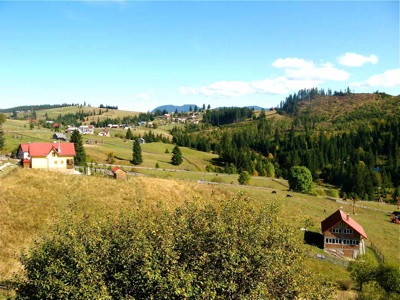
left: Typical rural view in Bucovina
And we had to find another place for dinner.