The Painted Monasteries

III: The Painted Monasteries of Bucovina
There is a lot of natural and simple beauty in the unspoiled landscapes in Bucovina. We see a wonderful panorama of hills and valleys, with friendly looking houses dotting the landscape. There is a wealth of religious art and beautiful monasteries, many related to the reign of the voivode3 Stefan the Great (Stefan cel Mare), who during his rule of 47 years had to fight 36 battles, of which he lost only two. Every time he won a battle, he built churches and monasteries to praise God for allowing him to win. His successor, Petru Rareş continued this tradition. In a recent survey, thousands of Romanians consider Stefan the Great the “Greatest Romanian” of all times.
There are some 48 monasteries in Bucovina, a number of them with huge frescoes painted on the exterior walls. Some of these churches have fortified walls to repel Turkish invaders, but they also managed to protect the exterior art work from the elements. Except for the north walls, the quality and the still brilliant colors of these vivid frescoes of Biblical figures and scenes, many dating to the 15th century, are amazing. It is awesome to see these huge frescoes, skillfully and lavishly presented to the admiring visitor, centuries later.
These paintings are also used for political propaganda. The Turks are always shown as the bad guys. Remember that in this period, the Turkish invaders were the greatest threat to the country.
A Voivode is a leader and can be translated as a prince or a king.
Mănăstirea Humorului.
The Humor Monastery was the first monastery we visited. It was built in 1530 by Petru Rareş. The predominant color of the frescoes is reddish brown. The frescoes date to 1535, and they were initiated by a daughter of Stefan the Great. This church does not have a tower, so it is not a royal church.
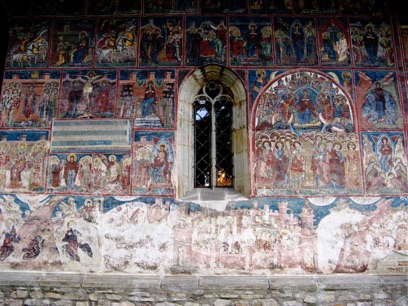
The portion of the fresco on the bottom is a bit washed out because of the elements. It shows the siege of Constantinople in 626.
Never mind that these were the Avars and the Persians who were attacking at that time; they were still depicted as Turks, the bad guys at the time the painting was made. We see here that the loose use of facts in political campaigns is not confined to US presidential campaigns only.
Voronet Monastery
This monastery was built by Stefan the Great in 1488 after his victory over the Ottoman Turks, in fulfillment of a promise he made to his spiritual advisor, St. Daniel the Hermit. The records show that the building was completed in 3 months and 21 days. As befitting a royal church, this one has a tower.
The frescoes were, however, not painted until 1534. A distinguishing color is “Voronet Blue”, a pigment created by the use of lapis lazuli. The most awesome fresco is that of “the Last Judgement” painted over the whole West wall of the building.
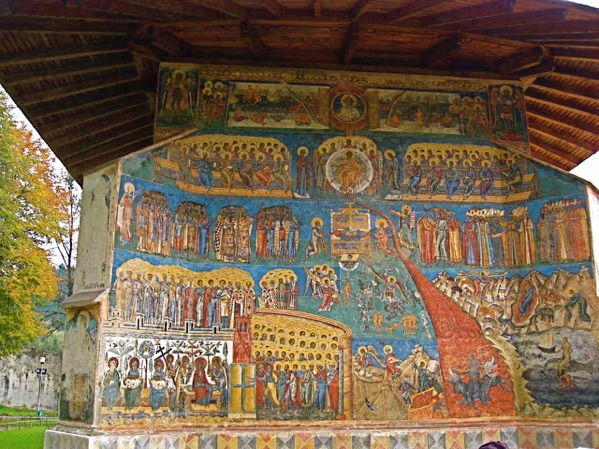
The Last Judgement.
God is shown in the middle top, in the shadows. Below him, in the white circle is Jesus Christ. Below this is a white dove, symbol of the Holy Spirit. To the left of the Dove is Moses. On the lower left of the main picture are, from left to right, Job, Isaac, and Abraham. The big red leaf on the right are the fires of hell with the devil on the bottom sipping a glass of wine. On the very right is the goddess of earth, Gaia, which is unusual, since she is from Greek mythology. Above her are drawings of tombs opening up on judgement day with people rising from the dead. Below the Dove is the soul of a person being weighed on a large scale. This can be seen more clearly in the close-up picture.

The picture above shows a portion in better detail. Guardian angels in the middle of the picture are pouring his good deeds in the left scale, while devils are pouring his bad deeds on the right scale. Depending on the outcome, he’ll go right to hell, or join the blessed on the left. On the lower left are two bars, but they are actually the gates to Heaven and the person next to it is Peter holding the keys in his hand.
Moldovita Monastery.
This monastery was built much later, i.e., in 1532, by Petru Rares, an illegitimate son of Stefan the Great, who later also became king. The drawings here are much more ornate than in the earlier monasteries.
The layout of all these monasteries consists of three adjacent chambers in a row, about equal in size to each other. There is first the entrance chamber. Humor and Moldovita are different, because they are the only churches where the entrance is an open porch. Then there is the middle chamber, which is often a necropolis. In this chamber is also often a secret door which leads to a space in the ceiling, where the church treasures are hidden in times of danger. The last chamber is the main sanctuary for the congregation to gather for services. At the back is the iconostasis, the wall covered with icons and paintings with a door in the middle leading to the inner sanctuary. During services, only the priest enters the sanctuary. Otherwise, only men can enter the sanctuary. A boy can be baptized inside the sanctuary; if the baby is a girl, then she has to make do in front of the iconostasis.

left: The Moldovita Monastery. The walls on the right of the window have northern exposure and all frescoes in that area have been washed away by the elements.
This church has an open porch, which would be therefore on the other side of the building.
There is also a fresco of “The Final Judgement”, and it includes the prophet Muhammad amongst the heretics.
If a church is a royal church, then it has a tower which is exactly in the middle of the main sanctuary. Looking up you will generally see a cupola with a painting of Jesus Christ. Because of the placement of windows in the tower, the light coming in will form a halo around the painting.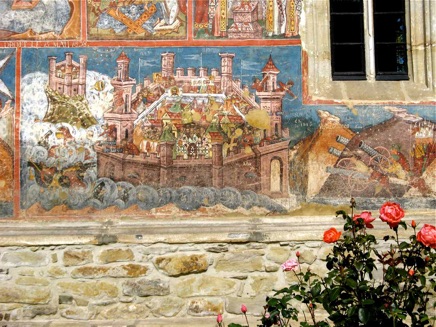
On the right is a close-up of the siege and fall of Constantinople to the Ottoman forces under Sultan Mehmet II in 1453.
The city walls are clearly visible. In the right in the walls is the Kerkoporta Gate, which appeared to have been left unlocked and through which the attackers finally rushed inside and captured the city.
The Suceviţa Monastery
This is the largest and also the most recent of the painted monasteries, built almost a century after the death of Stefan the Great. The story goes that in one of his battles his horse was killed under him and a soldier came by and offered the king his horse. Stefan was rather short in stature and the warhorse was large, so the soldier had to kneel for the king to step on his shoulders to mount the horse. After the victorious outcome he looked for the soldier and asked him his name. It was the equivalent of “flea”. That didn’t sound too impressive to the king. “Well”, he said, “as of today, you shall be known as Baron Mount”, or Movila in Romanian. The family fortunes rose in the subsequent years, and this church was built by two great-grandsons of the original Baron, Gheorghe and Ieremiah. By that time, Gheorghe was a bishop and Ieremiah was a voivode. Both these Movila brothers are buried in the middle chamber of this monastery.
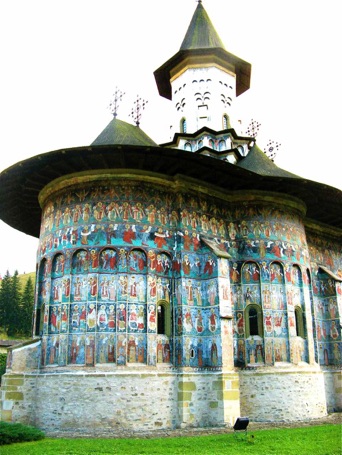
left: The Church of the Sucevita Monastery.
The dominant color of the frescoes here is malachite green. Artists have learned hoe to paint better and the faces are lifelike and full of expression. Inside the building a lot of gold leaf was used. The three chambers are richly decorated. On the walls of the entrance hall is an unusual calendar. It is a collection of drawings for each day dedicated to a particular saint. The fresco usually shows how the saint met his end, either by being beaten to death, hacked to pieces, or being subjected to other unpleasant things.
.
The detail on the right shows Sophocles and Plato, second and third from the left. Plato has a coffin with body on his head.
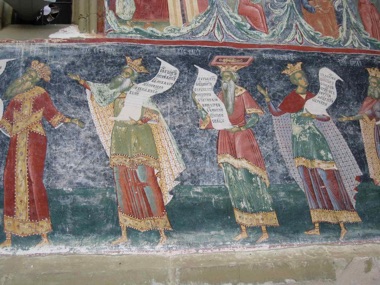
right: Detail with Greek philosophers
On the outside wall there is the fresco of “The Last Judgement”, which was left unfinished. The painter was killed when he fell from the scaffolding, maybe because he was in a too big hurry to get to his Last Judgement. Then there is “The Ladder of Virtue, with saints ascending to heaven and sinners (of course shown as Turks) falling down to be taken away by demons to hell.
The Black Pottery Atelier
On our way back to the hotel we stopped at the “Black Pottery Atelier at Marginea. Their pottery is made from the local clay and it looks and feels as if they were made from gunmetal. This is an example of an economic enterprise which has not joined the sharp increase in prosperity. We saw handmade vases, as high as 10”, with some hand applied decorations, going for only around $5. There is a lot of labor going into these vases.
The Best Western Hotel Bucovina.
After a hard day visiting the four Painted Monasteries, we decided to stay in the hotel for dinner. There was another business party, so they were not sure they could seat us for dinner. But there was lots of space and as bonus were also treated to the local folklore song and dance show for the business party.
We looked at the wine list. The average price was in the $10 - $15 range and we asked for something really good. Well, they has a 1980 Cabernet Sauvignon for $50, but the waiter would not guarantee the quality. We ordered it anyway. There was no label on the bottle, but there was a card and a certificate of analysis attached to the cork. The contents had been analyzed in 2005, showing 11.5 vol % alcohol, 4.7 g/l (as H2SO4) acidity, and 6.3 mg/l of total SO2, not much to hang your hat on. The wine tasted terribly; looked a sickly red and certainly did not handle like a 30 year old Cabernet Sauvignon. To me, it appeared to be an average house wine, a few years old, and artificially aged by using oak chips; I could discern a soupçon of a vanillin-like flavor. Probably bottled in 2005 and then sold to unsuspecting tourists like us. So much for the Best Hotel in Bucovina.
There was this nice-shaped building just in front of the hotel, obviously a church.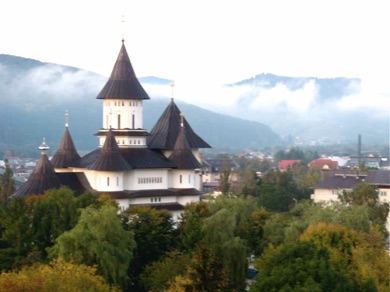
But none of the staff in the hotel knew it’s name. There are just too many churches in Bucovina, and they didn’t know which saint was going to get the honors.
left: The church of the unknown saint in Guru Humoruliu, in the morning mist as seen from our room.
The Neamt Monastery.
The next day we visited Neamt, the oldest monastery in Moldova and the first of the 42 churches built by Stefan the Great. It was consecrated in November 1497. There are no paintings on the outer walls, but the structure is similar to that of the other monasteries we saw. One of the treasures of the church is an icon of the Virgin Mary over 1000 years old, which was brought here from Constantinople. It was painted just before the iconoclastic period when the depictions of human form was forbidden. The other unusual aspect is that the church has two iconostases.
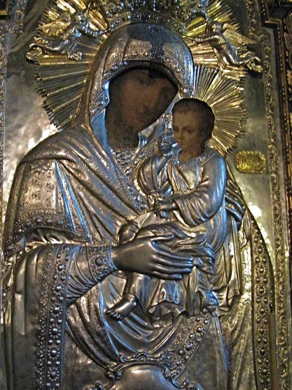
right: A 1000+ years old icon of the Virgin Mary. It is covered with a chiseled layer of silver and only the faces are visible.
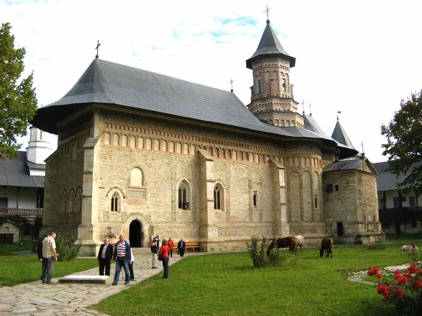
The Neamt Monastery looks, with small differences, like all the other monasteries built during this period. But this monastery does not have exterior frescoes and the stone slab indicated the spot where a relic was found.
During excavations some decades ago, they found the mummified remains of a person in religious garb. This was a miracle, since normally a person dead so long ago would now only be a skeleton. This unknown saint is now buried in the church and a stone slab on the path to the church marks where the body was found. (see picture).
They still tell the story with relish that the atheist Ceauşescu Communist regime heard about the miracle and wanted to confiscate the body. “What body?”, the local people said, looking blankly at the authorities. “Never heard of one”. They checked he church. There was no mummy there. The storm troopers left.
But when the regime collapsed, the body miraculously reappeared. Wonders never cease.
left: The Neamt Monastery Church