Food, Dracula, Gypsies, and Dogs

IV: Food, Dracula, Gypsies, and Dogs.
Food.
In Bucharest we had dinner at Byblos, on the Str. Nicolae Golescu, and we were impressed with the quality of the food. Both the ambience and service were excellent. And for what you get, it was reasonably priced. We had to make a reservation to get a table, because if you just drop in, you may not get seated. But was it Romanian food. Well, not completely. It was very good, French-oriented continental food, and the beef was tender and succulent. Haute cuisine has started to come up as part of the general increase in disposable income of the population.
A few days later we had dinner in Sibiu at the Crama Sibiul Vechi, or the Old Sibiu Wine Cellar, which was just around the corner of our hotel. It is presumably one of the best eating places in town to taste the local Romanian cuisine. It was even touted by Frommers. Their presentations were quite imaginative and I had one if their specialties, the Traista Ciobanului, or the Shepherd’s Bag. This was a thin slice of pork, grilled, which was used as a wrap for a blend of sausages, salami, and cheese. The bundle is stuck on a piece of polenta, a common source of starch. They also had a nice wine list.
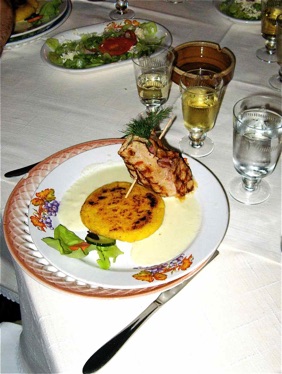
left: The Traista Ciobanului
When tasting Romanian cuisine, one has to remember that this country has always been at war over the centuries. You don’t really have that much time to develop the fine flavorings of a haute cuisine, if at any moment you have to flee the premises because invaders are at the gate. So there is a lot of grilled meats, which tend to be dry, but which is easy to make and easily transportable in an emergency. The meat is in general tougher than what we are used to. But give them a few more years of prosperity. The chefs will find a way, where the presentation will be even more imaginative, the meats more succulent and the flavors more rich and complex.
.
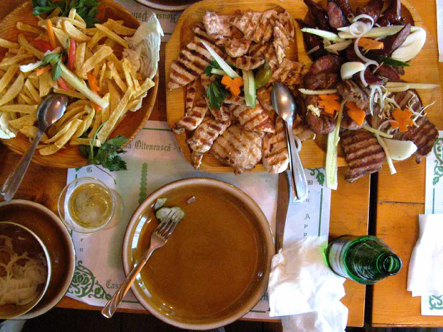
Well, so what else did we eat in Romania. The Romanians make great soups (ciorba), which can be a meal in itself. Just try the ciorba de perisoare, which is a spicy soup with meatballs and vegetables, or the ciorba de legume, which is a vegetable soup cooked in meat stock. Or try the ghoulash soup, even though it is Hungarian in origin. If you are lucky, the restaurant knows how to make one with just the right amount of spiciness. In Sinaia we had the venison and wild boar soup. Which was tasty, but it was difficult to distinguish the gamey flavor, if any. It was a place catering to tourists, and I wonder how much of the meat is true venison or wild boar. 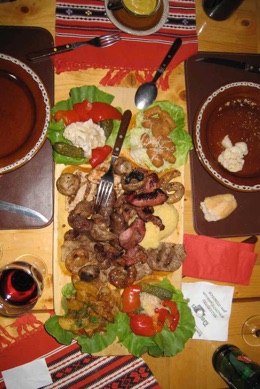 And one day I had the ardei umpluti, or stuffed peppers. Very nice. But watch out for their hot peppers; some of them are lethal. And Khoon, the eminence grise and gastronome par excellence of our group, loved their deep-fried chicken livers.
right: The ubiquitous platter of grilled meats and sausages.
If you are feeling a bit festive and want to eat something good, the main meal is generally a big platter with grilled meats and sausages. The sausages are usually very good. The meat can be chicken, beef, pork or a combination of the above. But some pieces can be very tough. The garnishing differs from one place to another, as well as the presentation. There may be chicken livers, mushrooms, etc. They usually serve these meats on a big wooden platter. For starch the meal is served with polenta or french fries. The breads are generally also quite good.
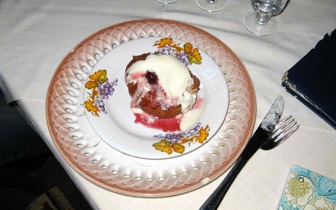
above: The ever-popular fried donut filled with jam and cream.
And outside Bran Castle was this shop where they were making and selling Kűrtoskalaçs, which is actually Hungarian in origin. This is a hollow roll of soft bread, about 4” in diameter, covered with sugar and walnuts. They are mounted on turning rods, which are slipped through the larg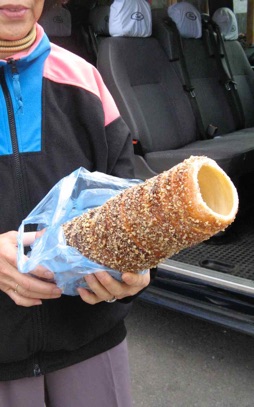 e hole in the pastry and the whole is heated over an open flame. The bread is still hot when they sell it to you right off the flames.. Very tasty.
right: A Kũrtoskalaçs ready to be eaten
Dracula
In a recent poll, the Romanians consider Stefan the Great (1433 - 1504) the greatest Romanian of all time. Regretfully, his name is not well known outside the country. It seems that non-Romanians only remember Dracula, the fictional character of Bram Stoker’s novel. This Dracula lived in a castle in Transylvania. He was a vampire, who slept during the day in a coffin, roamed the world at night, sipping blood from the neck of his victims, and transforming them into vampires at the same time. He was killed by a silver stake driven into his heart, but Anne Rice and other have successfully resurrected other vampires, with names such as Magnus and Lestat, to keep the dead brood alive.
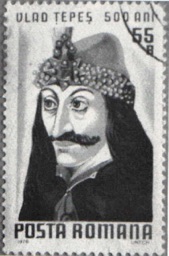
left: Romanian postage stamp showing the visage of Vlad Tepes, also known as Vlad Dracula.
But was there a Dracula in the annals of Romanian history? Yes; he was descended from Basarab the Great, (1310 - 1352) who is credited with the founding of the state of Wallachia. His great-grandson, Mircea cel Batran (1386 - 1418) was a voivode4 in Wallachia, and who is interred in the church at Cozia Monastery. There is a picture of him and his son earlier in this journal.
Before he died in 1418, he had appointed his son Michael as his successor. But two years later Michael was killed in a border skirmish and Vlad II, Michael’s half-brother, took over. Vlad II was stationed in Sighisoara as the commander with responsibility for guarding the mountain passes between Wallachia and Transylvania. And as such, Bran Castle must also have been under his jurisdiction.
In 1431 he was summoned by Sigismund, the Holy Roman emperor, to receive the signal honor of being initiated into the Order of the Dragon. This was a chivalric institution, created by Sigismund to “defend Christianity and do battle against its enemies.” Vlad II was so proud of this award that he then added “Dracul”, or “Dragon” to his name. So he was Vlad II Dracul (1436 - 1447). And his son, born in Sighisoara, was called little dragon, or Vlad III Dracula (1448, 1456-1462, 1476). In Romania Vlad III Dracula is better known as Vlad Tepeş, or Vlad the Impaler.
So these periods coincide with the time that Stefan the Great was in power in Moldovia in the North. Remember that the Vlad entourage was in Wallachia. As a matter of fact, in his early years Stefan at one time had to find refuge in Transylvania, when his half-brother was after him. He moved to the court of Vlad III Dracula, who seems to be his cousin, and with whom he seemed to have a close relationship. In 1457 he obtained from his host 6,000 horsemen as military assistance, putting them to good use in one of his victorious battles. In return, Stefan helped Vlad Tepeş when the latter wanted to oust his brother, the pro-Ottoman Radu III. As you can see, there is not much move lost between half-brothers. But Stefan would later marry the daughter of Radu III.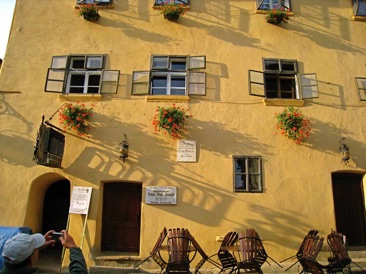
left: The house in Sighisoara where Vlad Tepes was born. It is now a restaurant, located in a prime location in the center of town.
Vlad II became voivode in 1436, and on the death of Sigismund, the Sultan demanded that Vlad II would give two of his sons as hostages in Turkey to ensure his reliability. The two boys, including Vlad III spent six years in Turkey. Vlad III came back and later became voivode for three separate periods. In Romanian history, he was better known as Vlad Tepes (Vlad the Impaler) instead of Vlad Dracula. He obtained this name because of his custom of impalement for execution of his enemies and of others, when necessary.
Although Vlad Tepes was to reign for less than 7 years, his reputation throughout Europe was widespread. He was to battle the Turks for many years, who launched a full-fledged offensive in 1461. Badly outnumbered, Vlad used guerilla tactics and germ warfare by sending victims of infectious diseases into the Turkish camp. He led attacks at night. But the Turks marched on and this is what they saw, when they reached the outskirts of Vlad’s capital. The text below is as described by the Greek historian Chalkondyles.
“He [the Sultan] marched on for about five kilometers when he saw his men impaled; the Sultan's army came across a field with stakes, about three kilometers long and one kilometer wide. And there were large stakes on which they could see the impaled bodies of men, women, and children, about twenty thousand of them, as they said; quite a spectacle for the Turks and the Sultan himself! The Sultan, in wonder, kept saying that he could not conquer the country of a man who could do such terrible and unnatural things, and put his power and his subjects to such use. And the other Turks, seeing so many people impaled, were scared out of their wits. "
The Turks withdrew. But in spite of such reported atrocities, Vlad Tepes is a significant figure in Romanian history. For one thing, he was a voivode who worked tirelessly for a strong, independent Wallachian state. He stood up against the powerful nobles and assured law and order in lawless times. But he is especially remembered for standing up against the Ottoman Empire, at a time when other principalities around him were buckling under the Turkish pressure. He is perceived as a David facing a Goliath.
Even though Vlad Tepes is honored by many Romanians, Bram Stokers’ Dracula is a great tourist draw and very useful for the economy. How to balance one with the other is not simple, and some entrepreneurs just see the crass opportunities related to the fictional character. I heard the story of a fellow selling special postcards in Sighisoara, the birthplace of Vlad Tepes, showing Vlad Tepes modified with the fangs of a vampire. “I only sell these postcards to foreigners”, he said apologetically, “I don’t sell them to Romanians, because they’ll get angry at me”.
voivode is Slavic word to denote a leader of a principality.
Gypsies in Romania.
Gypsies are also known as the Romani people, or as the Roma people, which is technically incorrect, since Roma is a noun. Roma are spread all over the world, but Romania has the largest Roma minority in Europe. It is so bad that in some European countries a Romanian is automatically assumed to be a Gypsy. Some 2 million Roma are estimated to live in Romania, which is therefore some 10 % of the population. This number is in dispute, because the Roma feel that they are a discriminated minority and that census numbers are only used to worsen their lot. So they don’t register.
The Roma originated in India. In one version they joined the Mongols in their sweep to the West, and then dispersed when the Mongols retreated. They were observed to have migrated through Mesopotamia to the Near East and to Turkey. Some settled in Greece. A different branch went through Armenia, the Caucasus, Russia and Scandinavia. By the 15th century, they were dispersed throughout Europe, including England and Scotland. At first, these people aroused curiosity and in some places they were actually welcomed, because they brought new technologies for working iron and other metals. They convinced the inhabitants that their migratory life was a punishment for renouncing Christianity.
But the norms of the Roma did not always agree with the norms of the surrounding majority population, especially in Europe. The Roma always lived in closed groups, their views on ownership were rather loosely structured, and over time the unfriendliness between them and the population have grown to what it is today.
It is sometimes difficult to discuss the Roma people objectively. Many Romanians have an extremely negative view of them, and some will not discuss them except in extremely derogatory terms. It is just as I found out during this last US presidential election that it was sometimes impossible to discuss the “fear” or “distrust” of voting for a black man. There are definitely more racial bigots in the USA than you would believe.
To many Romanians, the Roma are lazy and shiftless, who make their living by begging and appropriating properties which are not necessarily theirs. They live in the poorest neighborhoods in decrepit housing with no heating or running water. They cheat in their dealings and they deal in drugs and in prostitution. Or, they travel in carts along towns and villages, trying to make a substandard living by every possible, including dishonest, means. The Government has several programs to help them, but they refuse to make use of the opportunities granted,
From the Roma point of view, they have always been discriminated against; they have never been given the opportunity to obtain well-paying jobs and to be economically integrated in the community. They are blamed for all and any problems in the country. Romanians employers are reluctant to hire them. And if they do, it is only for menial jobs as laborers. The Roma are living at the edge of economic survival. Or disaster. If they cheat or steal, it is because they do not have a choice. If they travel in a cart, it is because they cannot afford a house and they have to find a place where they can make a living. Government programs have too much red tape and are ineffective. They are designed to make them lose their culture, and are not there to actually help them. Some Roma are moving to the surrounding countries just to beg, because of the hostile environment in Romania. But these countries do not want the Roma either.
There is the story of a Roma family who goes to beg in Bratislava in the summer and who is able to save about a thousand dollars in two months of “work”. 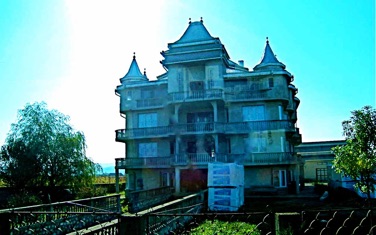 They then live on this money at home for six months. This is not much money, and even this avenue is closing down.
left: A house of a Roma family in the north of Wallachia.
But there are exceptions, of course. There are groups of Roma, who are successful. In some places in Romania we saw large, ornate, garishly decorated houses. To the left is a house of such a person. These people make a living as horse-breeders and goldsmiths.
In other countries they are also more accepted, such as those living in Spain, England and in the USA. In Madrid alone, there are presumably more than 100 Romani churches.
Dogs
You see a lot of stray dogs running around in Romania. And even though it is difficult to determine ownership, most of them are well-behaved and look comfortably fed. They are seen everywhere; not only in rural areas, but even in Bucarest. We had lunch on a sidewalk restaurant, and there were a number of dogs waiting patiently for handouts. They get enough. 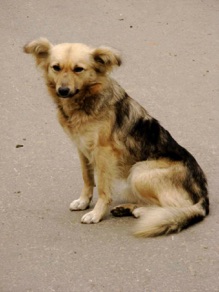
right: An adorable stray pooch on the grounds of Humor Monastery
Maybe they don’t have masters, but since there is enough food around they do not starve. It also seems that even with so many dogs around, their droppings are not everywhere. They must go away from the beaten path to do their business.
Many of these dogs do look very adorable and are probably ready to be adopted by anyone so inclined.
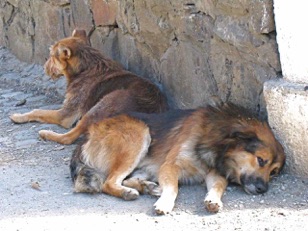
left: But these dogs in Sibiel looked rather scruffy.
Now I’d like to digress to our trip to Tibet in 1998. There, in the villages in the countryside we saw many stray dogs too, non-aggressive and just roaming around. Except when we were in Djeprung Monastery in Lhasa. The previous year’s issue of Lonely Planet warns about the large number of dogs in this monastery. Several tourists have apparently been bitten and we were prepared with umbrellas and sticks to ward them off. But when we came there, there was not one single dog around !!
That was a very unusual sight. We asked the people what happened to the dogs and all their answers and body language were very evasive. They could see we were foreigners. I suspect the authorities must have taken very drastic steps. The Lonely Planet is obviously read in Tibet. During our whole stay in Lhasa, we did not see more than a few dogs in total. The others must have been transformed into snowbirds, who leave when the tourists come. Or somewhere there must be a huge mass grave for dogs.
In some parts of rural China, dog meat is a common part of the menu. Maybe not as often as pork, beef or chicken, but you see them on the restaurant menus. You don’t see any stray dogs in those regions. They have all disappeared into somebody’s dinner pot.