Bucharest
Bucharest

I: Bucharest
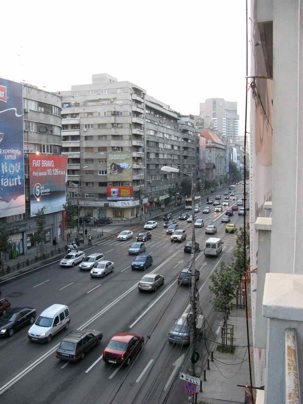
Cristian picked us up from Otopena airport in his 8-passenger Ford van, the same vehicle he used to drive us around the country, and dropped us off at the Lido Hotel, extremely well situated in the middle of the city. It was a nice and friendly hotel, not exactly worth the 4 stars it sported, but more than adequate for our needs. Within walking distance from the hotel are many eating places. Also close by are the historical areas, such as Revolution Square, where many buildings of historical significance are located, such as the erstwhile headquarters of the Communist Party.
left: Traffic is already heavy in front of our hotel at 7 a.m.
Bucharest is very green; there are many trees, man-made lakes, parks, and wide boulevards. One of them is wider and longer than the Champs Elysées in Paris, it has many fountains on the median strip, and it is lined with linden trees, reminiscent of Berlin. The houses are built in a very large variety of styles, including classical to neo-classical, renaissance to modern. There are even houses in Turkish design, dating from the 20’s.
As a visitor to Romania, you will sooner or later bump into the ghost of Nicolae Ceauşescu, the dictator who ruled the country for three decades. In the beginning he must have been quite liked. But economic mismanagement, ruling the country with increasingly iron hand to suppress dissent, as well as imposing a cult of personality for his own eternal glory, did him in. In Romania, it is now quite safe to speak disparagingly of him. Everybody appears to concur. The other person you can also safely speak disparagingly about is President Bush. His popularity rating here is probably even less than the 25 % he now enjoys at home.
The Communist Party Headquarters is a huge, squat, graceless building which is typical Russian Communist in architecture. Here, on December 21, 1989, Ceauşescu must have stared in disbelief from the balcony as the crowd turned on him during his speech. The building was defended by his army and his tanks and as the mob became more vociferous, he gave orders to fire on the crowd. But the Minister of Defense refused and Ceauşescu killed him, reporting to the outside world that the man had committed suicide. He was a beloved general, and when the troops heard what happened, the tanks of the Ceauşescu tank brigade turned around 180 degrees and started to fire on the building. Ceauşescu, his wife, and a few of his henchmen fled the building in his helicopter, but the Romanian Air Force forced it down. He commandeered a passing car. But they were captured a few hours later, just a few miles from the airport, where a jet was waiting to take them to safety abroad. A few days later they were tried and executed. It was Christmas Day, 1989.
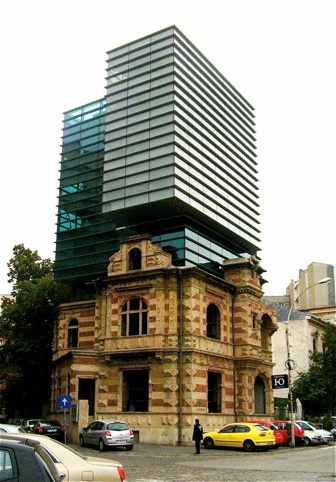
left: The erstwhile command center of Ceauşescu tank brigade.
Looking at the Party Headquarters, there is small building to its left. It used to house the command of the tank brigade, the one which changed the course of the revolution. It still stands there, pockmarked by bullet holes, but the top has been replaced with a new all-glass building. The Bucharest architectural review board is said to have their offices there. Like the phoenix, the virile new is sprouting out of the decrepit old.
The Athenaeum.
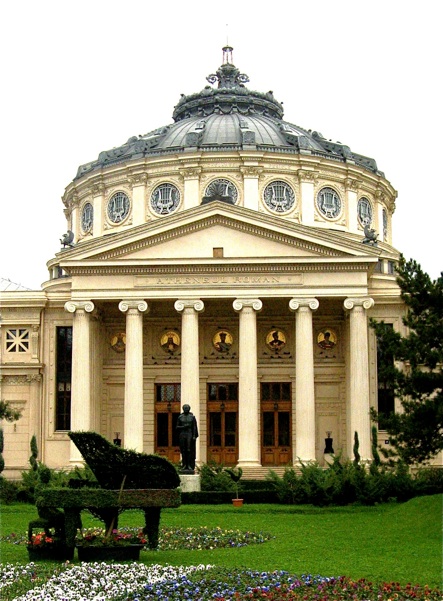
On this square is also the Royal Palace, now home to the National Art Museum, and the stunning Romanian Athenaeum, the work of French architect Albert Galleron, who also designed the National Bank of Romania. The Athenaeum was completed in 1888, financed almost entirely with money donated by the general public. One of the preeminent public fundraising campaigns ever in Romania, the “Give a penny for the Athenaeum” campaign saved the project after the original patrons ran out of funds. With its high dome and Doric columns, the Athenaeum resembles an ancient temple. And on the lawn is little whimsical touch, a bush trimmed in the shape of a concert pianist. That part needs a manicure daily. A picture of the building and the concert pianist is shown above.
The Kretzulescu Church
Close to the square proper there is the small and lovely Kretzulescu Church, built in 1727. It looks nice from a distance, but rather loses its luster when having to view the inside with a couple of dozens of additional bodies jostling for space to make their pictures of a lifetime. If you want to enjoy the amazing beauty of the interiors of the churches in this country, going with some 40 other participants is not the recommended way. At least you can make good pictures of the beautifully decorated ceiling.
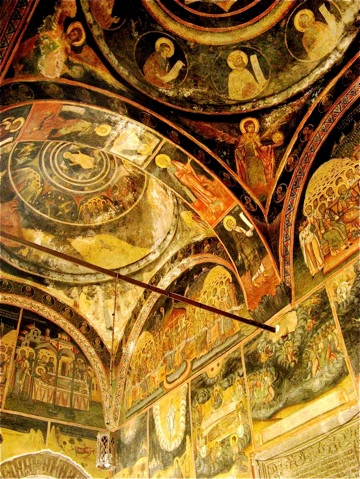
Unless all you were only interested in the paintings on the ceilings and the frescoes on the higher up walls. They were just plain marvelous. They were painted by Gheorge Tattarescu in 1859-1860, and they have not lost their original beauty in the intervening years.
The National Military Museum
This Museum is not really high up on the list of established tourist attractions of the city, but this is actually the best place to start a tour of Romania. The country has had so many wars, that the history of weapons of the area is also the history of the nation. The museum has three floors and it covers in fairly good detail the history of the region from around 5500 BC to the present.
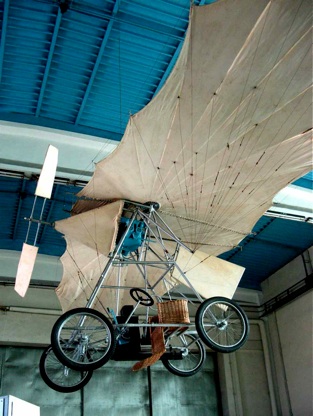
Also in the back is another building, this one an aeronautical museum. In it is a replica of the oldest airplane in the world with wheels --the plane of the Wright Brothers had skids--, a replica of the oldest airplane used to direct artillery fire from the air, and a replica of one of the earliest jet-propelled airplanes. These airplanes were all built by Romanians. There is also a Russian module from one of their space explorations.
left: The first-ever airplane with wheels, Romanian built, of course
The Palace of Parliament.
Cristian calls this building humongously grotesque, and I tend to agree. Driven by the same forces of overblown self-grandeur, which led the Babylonians to the construction of the Tower of Babel, this colossal monstrosity was built by Ceauşescu as a paean to his obsession with self-aggrandization. In volume, the structure is only exceeded by that of the missile assembly plant in Cape Canaveral and the pyramid of Cheops. It is the largest building in the world after the Pentagon.
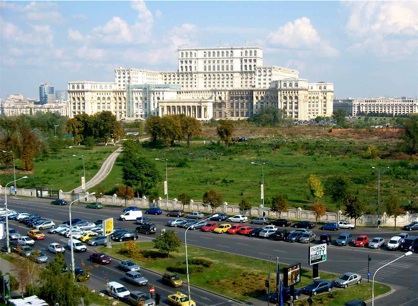
right: The Palace of Parliament from our room at the Marriott Bucharest.
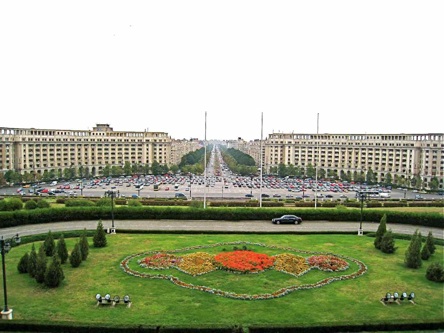
From the balcony there is the view of a huge square where thousands of people would be able to congregate to listen the dictator’s speeches.
below: Nothing like this view to stroke your ego as you address thousand of people on the square in front of you.
The ground in Bucharest is not very stable and to prevent earthquake damage, buildings have to be built on pilings drilled several hundred feet in the ground to bedrock. So to build this edifice they looked for the most stable area in Bucharest, which was then demolished to make way for this structure. About one quarter of the historic center were razed to the ground, including 26 churches. And some 40,000 inhabitants had to be relocated.
These are the prerogatives of being a dictator. His name and his building will live in perpetuity. The poor taxpayers, who financed the structure, and the workers, who have toiled long and hard, will soon be forgotten.
The Village Museum.
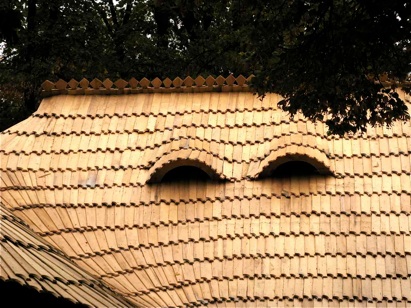
right: Attic windows on the roof of a house
An interesting custom in many parts of Romania is the inclusion of attic windows, often in pairs, in the roof of their houses. They are usually not very large. In this example, they are quite small, as if a pair of eyes are watching you from the roof. Look also at the interesting shape of the tiles. This one is actually from a house in Maldăvești in the region of Vălcea, about 100 miles northwest of Bucharest.
The Bucharest Opera.
We had the opportunity to attend Opening Night of the 2008-2009 Opera Season in Bucharest. Opera is a good gauge on how far the upper echelon society has progressed in the free capitalist world and we were very happy to be able to attend this performance.
Most of the older people in the audience were dressed nicely, the men in suits, but there were no stunning gowns on the women. That will come in a few years, I am sure.
left: Interior of the Bucharest Opera
Many in the audience were younger and they were much more casually dressed. There were also some 40-50 very well-behaved children in the 6-10 year old range, accompanied by nervous-looking chaperones. They start their kids early here. On opening night of the Bucharest Opera, nevertheless.
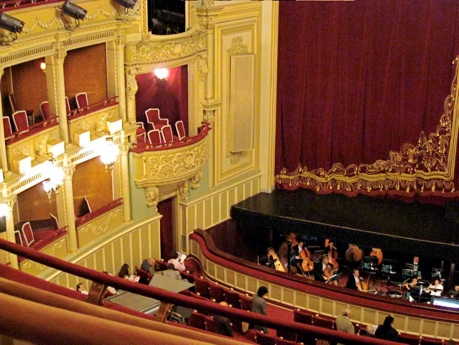
We had good seats on the first balcony with an excellent view of the stage and orchestra. Our tickets were around $10 per person, definitely more economical than the $75 tickets my wife pays for her tickets to the San Francisco Opera for a seat close to the rafters. And I don’t believe her seat has a better view. The voices were surprisingly good, quite comparable to the voices in the best second-tier opera houses in the USA.
We had observed the same thing in Prague, when we were there earlier. To make the event more attractive, they had hired two foreign artists to sing the lead roles in Aida. The local mezzo-soprano who sang the role of Amneris, was actually just as good. I suppose the local Opera Board was not confident enough to use local talent only for opening night.
But they do need to do something about the air-conditioning. With so many people in the building, it gets stifling hot after the half.
Fall, 2008