Taiwan

II: Sun Moon Lake
links:
III: Puli, Guanziling, and Kaohsiung
(a) Rihyue village
We left our hotel in Taipei at around 10:30 a.m. and drove to Sun Moon Lake, the largest lake in Taiwan and also a major tourist attraction in Taiwan. Halfway our journey, we stopped at the shopping mall of a small town for a cup of coffee and a visit to the pee-stations.
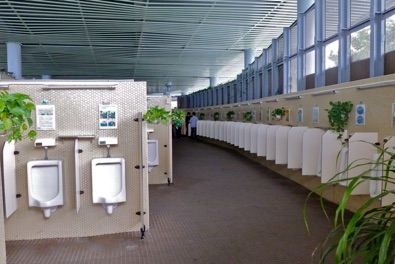
left: In this small town is this building with a surprisingly large number of urinals.
Mind you, this was just a small shopping mall, and there was no large stadium nearby which could disgorge thousands of visitors in a short period of time. But we found the public restrooms to be surprisingly large. Look at the huge number of urinals present in the picture. There are most probably more urinals here than in all of the restrooms in Yankee Stadium.
This phenomenon seems to be quite common in Taiwan. In many locations, where you would expect to find 1-2 urinals, based on what we see in other countries, it is not uncommon to find 6-10 here. I suspect the urinal manufacturers have been able to pass a law requiring this excessive number of urinals at any public location. That way you don’t have to wait and you have a choice. Maybe a high-ranking official peed in his pants because he had to wait.
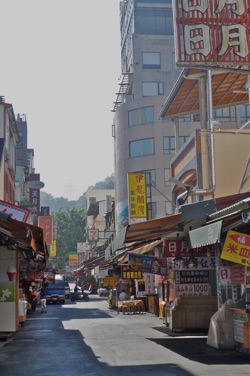
right: Rihyue is a small village with shops lining the main street, selling snacks, tea, etc. for tourists to the lake.
Arriving at Sun Moon Lake, we stopped in Rihyue village at the Einharn Resort for lunch. The dining room was on their fourth floor with a gorgeous view of the lake. In Taiwan restaurants stop serving lunch at 2 p.m. sharp, so if you are a few minutes late, you are our of luck. We just came a few minutes before 2 p.m., just before the staff closed the kitchen, so we did get our lunch. Which was plentiful and good and, as befitting Taiwan, very reasonable priced, which was about US$60 for the 8 of us.
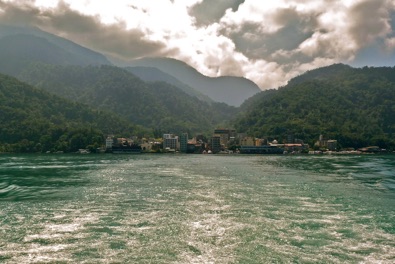
left: The village as seen from the lake.
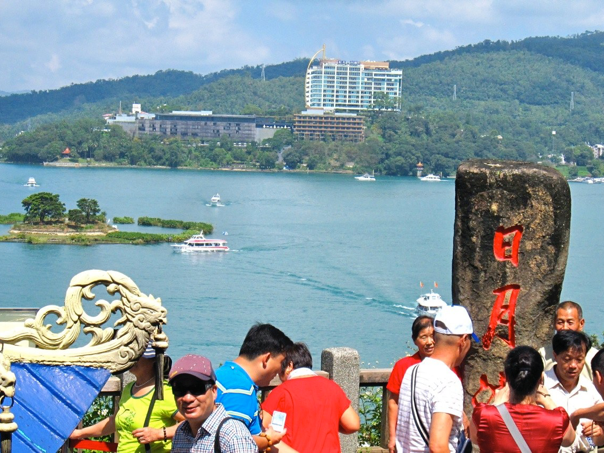
With a little bit (actually quite a bit) of imagination you see that the east side of the lake resembles the round sun, and the contours of the west side of the lake is like a moon. And that is where the name of the lake was derived. It is a clear lake, about 2500 feet above sea level and 90 feet deep. The area has been designed one of the thirteen National scenic areas in Taiwan.
There is a little island in the lake, named Lalu. Swimming and fishing in the lake is actually only allowed for the members of the Thao tribe, one of the smallest aboriginal tribes left in this area. Except during the Mid-Autumn Festival when hundreds of people plunge and swim 3 kms in the lake to the island.
(b) The Crystal Resort Hotel Sun Moon Lake.
At Sun Moon Lake we had reservations at the Crystal Resort, located in Rihyue Village. It is a small luxury boutique hotel with only 20 rooms, There were three couples in our group and we had booked two lake-view and one interior room. They have were very beautifully appointed rooms in general, with maybe a tad too many mirrors to create the feeling of spaciousness. From the lake view rooms the breathtaking vistas mirror the serene beauty of the lake, especially in the misty mornings. And the marvelous panorama can be enjoyed, even when you are lying in bed. The interior room, on the other hand, only looked out at the walls of the adjacent buildings, just a few feet away, but it was some 40% less expensive. Take the lake-view rooms and enjoy life.
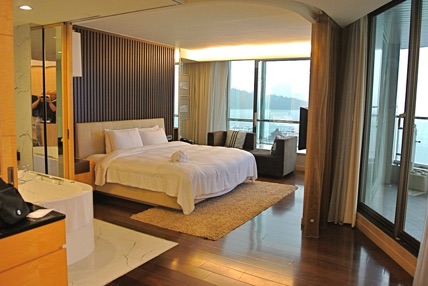
right: This is part of a lake view room; it has two verandahs, a jacuzzi bath, and other nice amenities.
The luxury bathroom is not visible in the picture. The rate was $310/night, which you would have paid for a similar lodging in other fancy resorts in the world. Here the price includes half board for two, Wi-Fi access in the rooms, and private parking. The staff may sound a bit formal and aloof at check in, but they are actually very good and most helpful and accommodating throughout our stay. And after chatting with them for a while, they were very pleasant and friendly. This is maybe partly cultural.
There are two main ferry terminals in Sun Moon Lake; the tranquil one is located just outside the hotel. The other one is located at the other side of the lake and it is quite busy because of the many larger hotels situated there. There is, therefore, not that much traffic around our hotel.
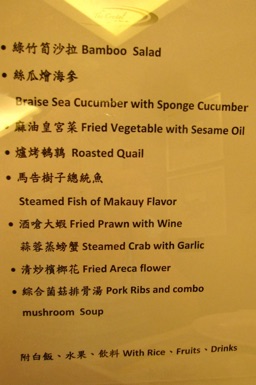
Dinner at the hotel was the set menu is shown here. This was not a simple meal, but a very well prepared gourmet dinner. I did have some problems with the crabs; they look beautiful, but they did not have much meat. So there was a lot of work involved to eat them. But all the dishes were extremely well prepared and nicely served.
left: Menu for dinner for half-board at the Crystal Resort.
Note that the soup is served at the end of the meal.
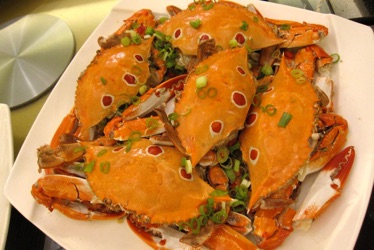
right: The crab was beautiful, but there was a lot of work involved in getting the meat out.
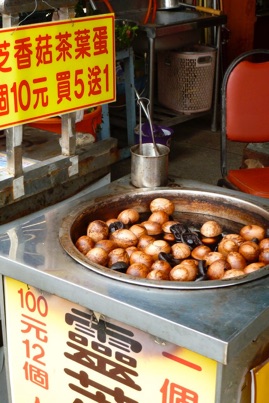
The village itself is small and friendly and obviously geared towards the tourist trade. There are many little shops selling products and snacks from the region. You can get the colorful costumes of the local aboriginal Thao tribe, fruits, the very good and well-known local teas, and crisp, deep-fried small fish and shrimps for snacks. There are small restaurants and eating places catering to the visiting tourist.
left: This shop sells tea eggs; eggs hard-boiled in tea laced with shitaki mushrooms. One egg is 10 NTD or US$0.34, buy 5 eggs and get one free.
I don’t know what the presumed properties are of these eggs. I guess people just like the taste of tea in the eggs.
(c) The Xuan Zang Temple.
We took a boat trip on the lake to visit this temple. The pier was just outside the hotel. The fare was NTD 300/pp for which you can travel all day on the boats of the company you bought the ticket from. That sounded good, but it was a bit tricky, because there are several different companies operating these boats on the lake. And if you step in the wrong boat, you’ll have to buy a new ticket.
Xuan Zang (600 - 664 AD) was a monk during the Tang Dynasty. Also known as the monk Tripitaka, he started his journey from the Middle Kingdom to the West in the year 627 AD in search of Buddhist scriptures to answer the crucial questions of the faith. It is said that his journey is also an allegorical depiction of the growth in the spiritual development of a person looking for wisdom and ultimate truth.
His journey has become the stuff of legends and fiction and is the basis of the fictionalized report “Journey to the West”, which involved the involvement of innumerable deities, spirits, monsters, heavenly warriors, and the incomparable Sun Wukong, the monkey king. It is actually one of the four Great Classical Novels of Chinese Literature, and it is attributed to Wu Cheng’en as the author.
.
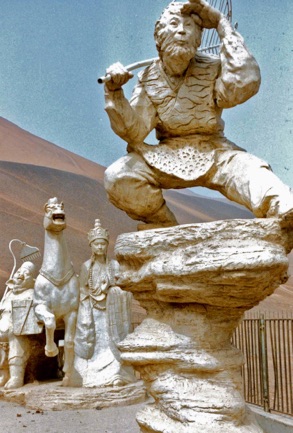
right: Somewhere in the Gobi desert near Turfan is this statue of Sun Wukong, the monkey god, checking out the path for his master, Xuan Zang, on their Journey to the West. Behind the monk is his white steed, who is actually a dragon prince conscripted into service, and the monk’s second helper, Zhu Bajie, the pig.
The journey of the monk took him through the inhospitable Gobi desert, where he stopped in the city of Gaochang. In 1997 we were at the remains of Gaochang city, also known as Kharakhoja, 47 kms southeast of Turfan. Xuan Zang was here 1400 years ago.
It was the capital of the Uygur kingdom of Gaochang under the Han house of Qu. The city itself was first built in the first century BC. It was also a major staging post on the Silk Road.
Very little remains of the city which, during the Tang dynasty dynasty, housed more than 5000 people. German archaeologists dug extensively here and found superb floor mosaics, frescoes, statuary and even manuscripts. But little is left now. The walls are still clearly visible on same places. They were 12 meters thick. The perimeter of the city was about 6 kms long and there used to be a moat around it. All this to no avail when the hordes of Genghis Khan came down from the steppes of Mongolia to conquer and destroy.
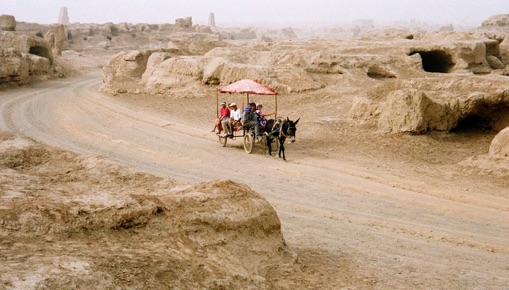
right: Remains of Gaochang city. The donkey cart is the “bus” taking tourists around the ruins.
It is now just a jumble of desolate formless ruins, but here the monk stopped on his journey to the West.
The king of Gaochang, hearing that the famous monk was passing by, welcomed him at the gates of the city and insisted that he stayed there to teach him and his wives. The teachings were done in a roofless teaching hall, about 10 m by 10 m large only, the ruins of which are still visible. Tang Xuan Zang stayed in Gaochang for three months and he had to go on a hunger strike to have the king allow him to leave. The king loaded him with gifts which paid for the expenses of his trip further down the road._
But I digress, which I am allowed to do, since these are my writings.
The rest of his life he spent in translating these scriptures from Sanskrit into Chinese and when he died, he was buried in Nanjing. But during the war between China and Japan, the Japanese Army took his remains away and moved them to the Jion-ji Temple of Saidama Ken in Japan. Only in 1965 were his remains moved back to China, i.e., to this Xuanzang temple at Sun Moon Lake.
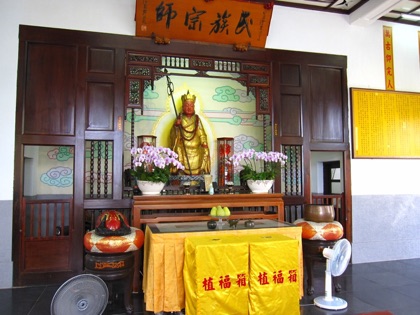
right: Inside the temple is an effigy of the monk
The temple is built on a hill on a wooded promontory on the the lake. It is supposed to be a quiet place for introspective meditation, but when we were there, the place was a zoo. The major problem seems to be that from the hill is a beautiful view of the lake and the surroundings. The Chinese have discovered traveling and tourism and with their new-found wealth and prosperity they are now all over the place.
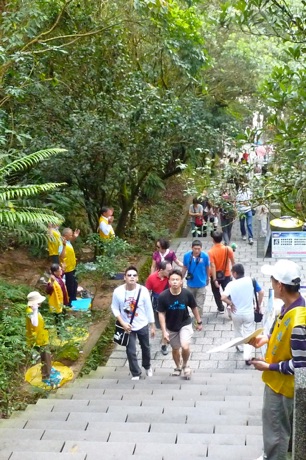
On our way up there were members of the Falung Gong trying to induce the visitors walking by to join them. They are a prohibited entity in mainland China, but here apparently they can still operate to spread their beliefs and are still actively trying to recruit more people to join their ranks.
left: On the left of the picture you can see some 5 members standing on colored cloth in a trance with their arms up and palms upwards, while on the right a member gives out brochures to the people passing by.
3:14 PM