Taiwan

III: Puli, Guanziling, and Kaohsiung
links:
(a) Puli and the Paper Dome.
Puli is located in the mountains and has a very desirable climate for Taiwan, with relatively dry winters and cool summers. In Puli, which is about 20 miles from the Sun Moon Lake, we stopped at the Aunt Ama restaurant, which served aboriginal food. Which did not impress us very much. From there we went to the Paper Dome, which was located close by.
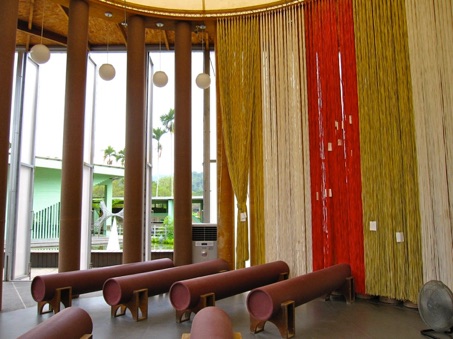
left: Interior of the Paper Dome. The building is actually not very large and can seat not more than 50 comfortably.
The Paper Dome is a small, but quite unusual elliptical church built of (mostly) paper. It was designed on a pro bono basis by Shigeru Ban, a Japanese architect, already well-known for his paper tube structures and buildings. This building was first erected in Japan after the Great Hanshin earthquake in 1995. In that disaster some 60 % of all buildings in Kobe were destroyed, including the Takatori Catholic Church.
But a statue of Jesus was unharmed in this disaster, which was considered a miracle, and so the people wanted to rebuild the church as soon as possible. The architect designed and erected the temporary structure from 58 cardboard tubes; and with 160 volunteers the church was completed in 5 weeks. It became a temporary church and a community meeting place.
Then, in 1999, there was another big earthquake, this time in Puli, Taiwan. The Paper Dome was becoming too small for its original purpose in Japan, and so the members of the Church decided to donate the building as a symbol of friendship between the two countries. They had both faced the adversity of earthquake disasters. Since the structure was made of paper, it was clear that there would be a lot of officious paperwork involved. It took several years before the official papers were signed by the public servants. Then the structure could be dismantled, shipped and rebuilt in Tao-Mi village in Taiwan.
In the picture you can see the paper tubes, 13” in diameter, made of paper, 1.5 cm thick, used as columns and as seats. The pillars are 5 meter high. The paper is coated with a water-resistant coating. Although each tubular bench only weighs 125 lbs, it can support up to 1500 kg in weight, or some 25 adults. The Paper Dome Church was actually not opened in Puli until 2008, 9 years after the disaster. Yes, Government employees can be annoyingly slow.
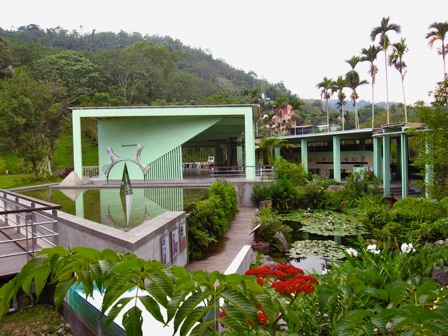
right: The Paper Dome is not standing by itself; it is located in an architecturally pleasing park with other modern buildings, sculptures, ponds, pools, and fountains.
One nasty drawback is that there were a lot of mosquitos there, many of them small and difficult to see. Yet, they were quite capable of delivering some stinging bites. You just have to spray yourself with insect repellant to avoid being another victim of sting and run.
The entry fee was NTD 80/pp, but they will give you full credit for this amount if you buy some stuff from the museum store.
(b) Guanziling Hot Springs
From the Paper Dome, Dustin drove us to Guanziling, Baihe, a two-hour drive covering 144 km. The Guanziling Hot Springs are unique mud springs; there are only three like this in the world, the other two are in Italy and in Japan. These springs are in the mountains more to the middle of the island and outside the heavily traveled tourist path. So, that was very attractive to us.
Guanziling itself is a large loop several miles long, in the hilly terrain, with houses and hamlets along this road.
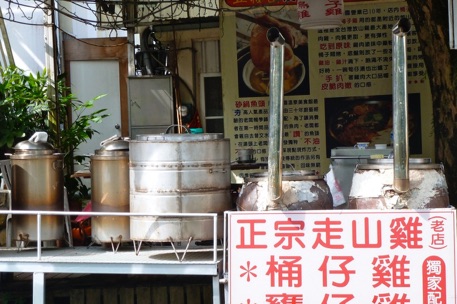
left: We passed this restaurant interesting “kitchen” with large ovens and steamers on their front porch. Looks like they are only serving some special dishes.
We stayed at the Toong Mao Guanzilin Resort,close to the top of the loop, where we had booked standard double rooms for around $80 each, breakfast included. But we decided to upgrade for an extra $30 to a larger room with an indoor private spa.
Adjacent to our rooms, on the 5th floor, there is the outdoor balcony, chastely covered with screens so birds and any wandering spacemen would not see us cavorting in the nude. Because on the balcony is the stone bath as well as a shower to clean up afterwards.
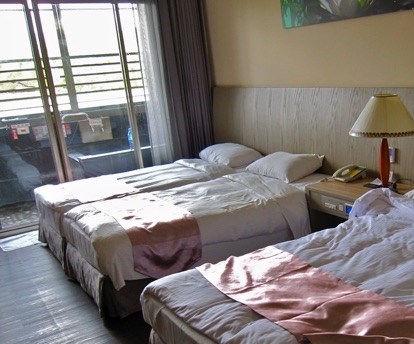
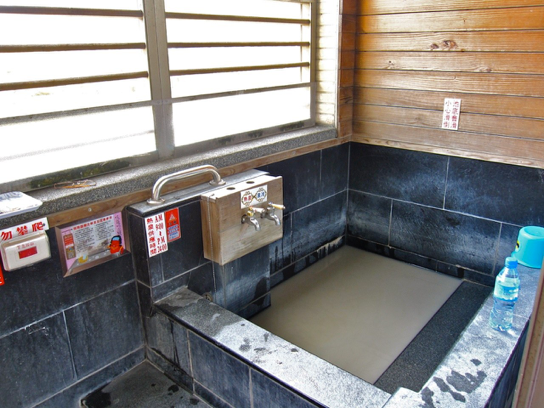
right: The rooms had four beds, and a bathroom ensuite. But you can see on the balcony the stone tub where you can have your hot bath with spring water.
Although we were on a high floor, it took only about 10-15 minutes before the muddy water coming from the faucet became piping hot. It was not really mud; it was water with some light-brown mud, presumably loaded with minerals and other healthy stuff suspended in it. There was probably not more than 1-2 ounces of mud solids in each gallon of water. You can see from the picture above, the stone bath and the mud-colored water in the pool. But it was indeed very relaxing to soak in the muddy hot springs water and pull up the sun screens, so you can enjoy the sunshine and the view.
After the soak, you can wash off in the adjacent shower and your skin will feel smooth afterwards, because the mud is alkaline. That was a major selling point for these baths, especially for the ladies, but I am not sure whether long-term exposure would be beneficial to the skin.
The hotel also has several outdoor pools, where you can soak yourself, in bathing attire, I suppose. If you are not a guest of the hotel you can also soak in these pools for a small fee. Inside the building there are also covered pools, one for men, and one for women, where no clothing is allowed when in the water.
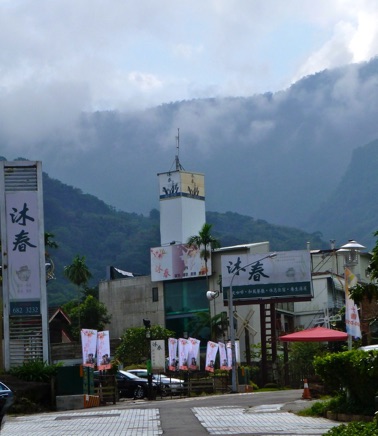
left: A restaurant in this mountain village. It was rather misty because of the high altitude.
We were tired and too lazy to go out for dinner and so stayed in the hotel to partake of their standard menu. We ate family style. There was steamed rice and some 10 dishes, most of them vegetarian, and the bill was 300 NTD or about US$10 per person. This region is obviously not on the expensive tourist track. In the price is already included a 100 NTD credit per person, because we were guests at the hotel. That was a great deal.
(c) The Fire and Water Spring.
This is crevice in the rocks from where water and fire simultaneously emerge. This of course very unusual, since we have been taught that fire and water are not compatible. This spring is located on the southwest flank of Zhentou Mountain, a few miles from the Toong Mao Guanziling resort. There is a geological fault in the structure along the Liuchong River, allowing underground natural gas to escape through the cracks in the rock into a chamber where spring water flows by.
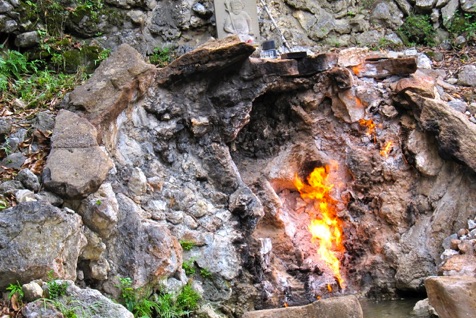
left: The Fire and Water Spring.
These gases, emerging along with the spring water, feed the flames which you see coming out of the grotto. Local lore claims that a wandering monk discovered this phenomenon in 1701. The flames were apparently very much larger then. From the size of the hole the extent of the flame could be very deep and very large. So this flame must have been burning for at least 300 years, beating all artificial “eternal” flames honoring the fallen in earlier wars.
There are two entrances to this spring from the main road. The sign for the first entrance coming from the Toong Mao Guanziling resort, shows the red flames and the blue water. You see this symbol everywhere in the area. There is parking for just a few cars and there are fairly steep stairs to get to the spring, which are impossible to traverse in a wheelchair. But a bit further down the road is a larger parking place leading to a small tourist village complex, which is on level ground. Walk through this village, buy some souvenirs and get some snacks, and at the end of the village you get to the spring. There are still stairs there, but not as steep.
I am not sure whether the flames were ever accidentally extinguished. But I am sure somebody will kindly light up the flame if it is accidentally extinguished. You certainly do not want the tourists to stop coming here.
(d) Kuan Tzu Ling (or Guanziling)
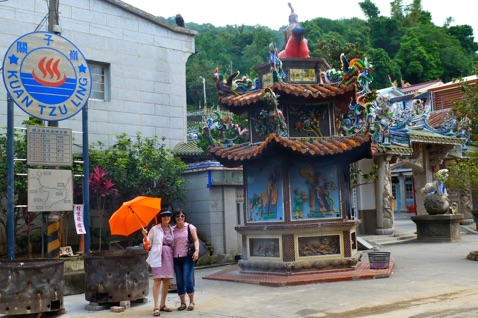
left: Center of village of Kuan Tzu Ling.
Our next stop was the village of Kuan Tzu Ling, graced with an ornately decorated Chinese temple and where we found, just outside the village, the cleanest and marvelous public toilets building ever. From the flamboyant porcelain decorations on the roofs and rafters, this building is obviously a Taoist temple.
The decorated hexagonal building in the middle is a large oven where friends and relatives can deposit and burn paper money, paper food, and other simulated necessities for the comfort of the afterlife of a dearly departed. There is a fire burning inside the structure and you can see some smoke emerging from the concealed chimney on the top. On the left top of the picture is the symbol of the area, flames and water.
(e) Eternal Golden Castle
Our tour took us to the ancient historical inner city of Tainan, where we stopped to view the Eternal Golden Castle, also called the Erkunshen Fortress, which was built in 1874, in the first year of the reign of emperor Guangxu. Shen Baozhen, the famous Qing official, built this fort to protect the coast from foreign invasions. And indeed, Japan invaded Taiwan in 1895, and the Taiwanese fought from this redoubt against the Japanese battleships.
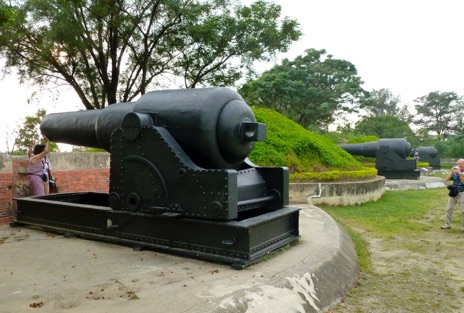
right: And here are the major cannons pointing out to the sea.
This is not a castle but a large rectangular fort, with a moat around it and a drawbridge for restricted entrance through the gate. Like all forts, the four corners stick out to protect the flanks.
Heavy batteries were located on the far side of the fort, facing the sea. In one section of the fort were the barracks of the soldiers. The square field in the middle was large enough for training sessions of up to 1,500 soldiers at a time.
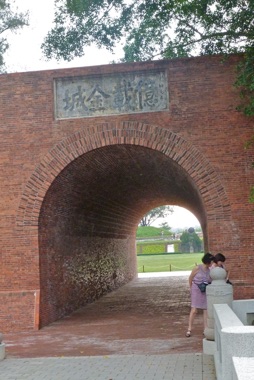
right: The entrance gate from the drawbridge, from where one can appreciate the thickness of the walls of the structure.
We drove further to Kaohsiung, where we had reservations at the Chateau de Chine. Kaohsiung is the second largest city in Taiwan, but we didn’t spend much time exploring the city. The hotel was only recently renovated some two years ago. It was done beautifully, with the interior full of modern touches and styling. The rooms had lots of mirrors and sliding doors to make more free space. There were also more practical issues handled well. The shower/bath area was separate from the toilet, with wash basins in each. There were waste baskets everywhere. Lighted panels indicate what is active in the room.
We met the American-trained Chinese manager, Jennifer, walking with her daughter Angela, and complimented her on the beautiful job she had done. We had dinner in the hotel also. Again, there was the surfeit of excellent food, including soft-skin crabs and a marvelous appetizer plate with peeled crab legs.
(f) The Rubber Duck.
The Dutch artist Florentijn Hofman designed these giant floating sculptures, called Rubber Duck, with which he wanted to entertain the world by a tour named “Spreading Joy around the World”. Since 2007, the ducks have been on display in many cities, starting in Amsterdam.
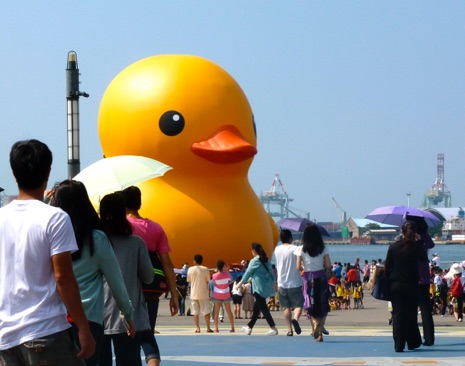
left: Big Rubber duck in Kaohsiung harbor
When we were in Kaohsiung, (it was September 2013) there was this big yellow rubber duck there, floating in the harbor. This one was said to measure 25 x 18 x 18 meters, and a lot of people were there to happily look at this yellow ode to joy.
(g) The East Coast.
Our tour required us to go to the East Coast of the island. But to drive to the East Coast from Kaohsiung you either have to make a huge detour around the south of the island or drive over the mountains to get there. It is a long drive over the steep mountains and we opted for the easy way to get there, which is by flying from Kaohsiung to Hualien. The fight was only 40 minutes; driving would take us at least 5-6 hours.
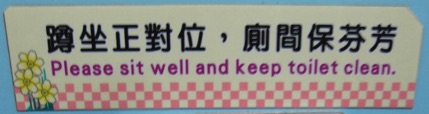
Mandarin Air has several flights daily between these two airports. In addition, Kaohsiung airport has this wonderful saying, which should be posted in every public toilet: No fiddling when you are sitting on the toilet and keep your mind on business.
2:30 PM