El Calefate and Ushuaia


El Calefate
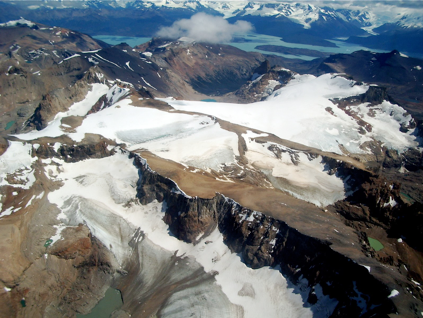
As the plane was making its descent into Calefate, the scenery unfolding below us was incredibly awesome. Mountains of brown rocks were interspersed with glaciers and dark blue waters. The Viedma glacier, which is the biggest glacier in the area, was clearly visible. El Calefate is on the West Coast of Argentina and the scenery was definitely different than that of the Valdés Peninsula.
Our weather fairy was doing her job again. The weather was beautiful. When we were here four days ago on transit, it was overcast, drizzling and cold. But today the sun was shining and the temperature was a balmy 70 degrees.
We were loaded in a bus, together with a number of other passengers, and dropped off at the various hotels. The Posada Los Alamos, on the Gobernador Moyano y Bustillo, was the biggest hotel in this small town. Tourism is the main industry here.. The hotel was located in a quiet area two blocks from the main street, which was also the center of town. It can get cold here, so the hotel had a good heating system, with good insulation and central heating. But they were not that well prepared for hot weather. Since it is seldom hot here, there was no air-conditioning. So we had to keep our windows open to catch some breeze. It was, otherwise, quite a nice hotel. We had the same problem some years ago in Helsinki, because we were there during one of the very few sunny and hot days in the year. The hotel, again very well insulated against the cold, kept the heat in, so we had to keep the windows open to let the air and the outside noise in.
It was a short walk of a few blocks to downtown. El Calefate is a friendly town catering very much to tourists and Norma got her daily ration of helado. Yes, there are helado stores everywhere in Argentina. Dinner was at Mi Viejo, which attracted us because it had a display of a lamb being grilled on a wood-fired parilla right in front of the restaurant. We had the grilled lamb in a mushroom Mornay sauce and half a bottle of Valmont red. The waiter said it was the most popular wine there; it was also the cheapest; but it was still quite drinkable. It was, otherwise, just a so-so restaurant. The service was slow, because there was a big group of Germans at a long table just ahead of us, and there was nothing remarkable about the food.
Minitrekking on the Perito Moreno Glacier.
The hotel restaurant had a superb buffet breakfast menu. A large variety of breads, fruits, meats, cereals, etc. There was even a bottle of champagne, in case you wanted to start the day with a Mimosa. There was also an opened bottle of red wine. And there was a special omelette chef to custom-make your eggs anyway you like it.
At 8:30 a.m. we were picked up by an almost full 50-passenger bus for our mini-trekking adventure. It was a 90 minute drive to cover some 75 kms, the last 20 km on a dirt road in the Parque National de Glaciares. Entrance fee to the park was 30 pesos/person for foreigners, 10 pesos/person for Argentines. I am afraid my Spanish was not good enough for us to pass as Argentines.
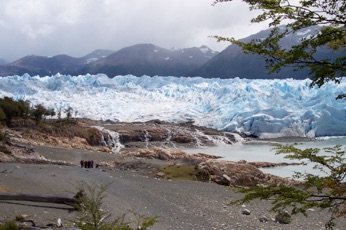
left: Path to the Perito Moreno glacier.
A short hike and then we were outfitted with crampons tied to the soles of our shoes. Most of the glacier itself was jagged and impossible to walk on. But the left side had rounded surfaces. There were 24 of us and two guides, expert young men who did not have any trouble at all moving on the ice. They were also very solicitous of our welfare and they were always there to help and prepare the path when we traversed a rather difficult part. But it would have been much easier if we had ski poles with us, because it was rather difficult, especially going downhill, with no additional support. We had told our neighbors, Bob and Carol Gray, about this, and when they showed up here a few years later they were well prepared. But then they were told not to use the ski poles they had so lovingly taken along. Well, sometimes you can’t win.
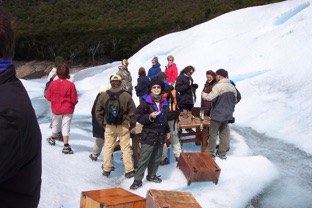
right: A table with chocolates and a bottle of whisky in the middle of the glacier.
A table with chocolates and a bottle of Famous Grouse whisky. In the middle of nowhere; on the ice. Cheers, everybody got to nibble on chocolates and drink whisky diluted with 400-year old glacier ice. We told you this was a most civilized country.
The Perito Moreno glacier is unusual because in close proximity to each other you will find barren mountains and lush vegetation. You see this in the picture above. Secondly, this is the only glacier in the world where the foot of the glacier is still occasionally advancing. All other glaciers are steadily receding because of global warming. The foot of the Perito Moreno glacier actually moves forwards and back and has somewhat stabilized at the current position. Why is this so?
The prevailing winds in that part of the world are from the West, because of the rotation of the earth. These winds, saturated with water after skimming the Pacific Ocean are suddenly forced upwards many thousands of feet as they hit the Cordillera range of the Andes. The air cools down rapidly and the moisture becomes ice and snow which then fall on the Andes at the head of the glacier. Snowfall can be as much as 400” or more per year in that area. On the other side of the Andes, rainfall is as little as 12”/year. The snow and ice falling high in the Andes builds up on the head of the glacier and pushes the glacier forward and down. It takes a snow particle 300-500 years to move from the point of impact to the foot of the glacier where it will then melt in the lake. So, depending on how much snow comes down and how fast the ice melts at the foot, the glacier foot will move forward or recede.
At one time the foot moved so far forward it made contact with the opposite shore of the lake, effectively sealing the Brazo Rico from the adjacent waters of Lago Argentino and the outlet of the lake. A separate lake was formed where the water rose. There was fear of flooding. The military started shooting at the foot of the glacier to force a passage. They covered the area with soot to increase heat uptake. All to no avail. The passage was closed until the glacier decided to retreat on its own volition.
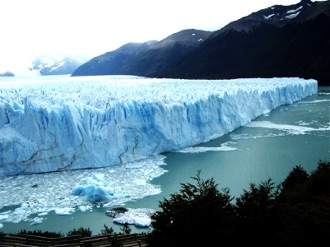
left: The Perito Moreno glacier from the Panoramic Terraces
Here we could see where the glacier almost touches the opposite shore of the lake, as well as the right front facing the Canal de Los Témpanos.
Just as the other front facing the Brazo Rico, this front was also jagged and steep. The face of the glacier is around 200 feet high and at regular intervals we could see big chunks of ice “calving” or falling down. The fall is always accompanied by a sharp crack.
That evening we had dinner at the restaurant of the hotel, La Posta. Both the food and and the service were exceptional, well worth the designated five-star setting. 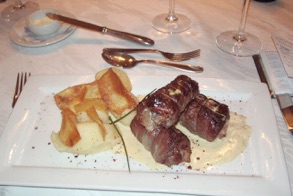 We shared a chicken appetizer, a beef dish, grilled vegetables, and a bottle of good Terrazas Malbec wine.
right: A superbly prepared piece of beef.
The bill was only 105 pesos. A similar dinner would cost over $100 in the States. We found that all restaurants do not mind if we share the food. “Puedo compartir”, I would ask. Most of the time they give us extra plates or even divide the dish on two plates already.
The Upsala Experience
Another day and another exciting tour was waiting for us on the programme. We had our excellent breakfast this morning in the hotel restaurant, even though we were told we would get breakfast on our trip. But life is uncertain, and we were not passing over a superb breakfast for something we knew nothing about. The bus picking us up was 45 minutes late, because the driver said he was not notified in time. We had to be in Punta Bandera, 20 kms away, by 8:00 a.m. when our boat was supposed to leave. It was 7:35 when we were all seated in the bus. There was a rosary hanging from the rear-view mirror and the driver moved his lips as he reverently touched the crucifix. Then he crouched forward, gunned the engine, and tore down the streets. The boat was already making preparations to leave when we were still about a quarter of a mile away on the long driveway to the dock. Our driver leaned on the horn to tell the boat to wait as he went into overdrive. We held tight. But the boat waited for us.
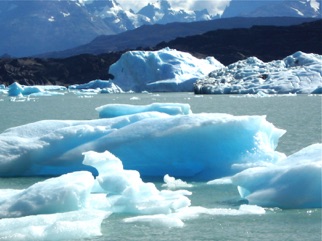
left: Ice floes on the way to the Upsala glacier.
The glacier was named after the research team from the University of Uppsala in Sweden, who did a lot of research on this glacier, but somewhere along the line they lost one of the p’s. 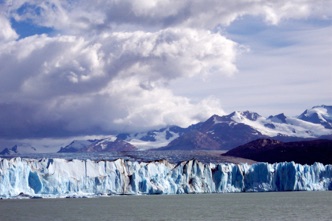 This glacier is 3 times the size of the Perito Moreno glacier and it is receding rapidly, about 10-20 meters/year. It is half the size of the Viedma glacier, the largest one in the area. It was a very impressive sight.
right: The face of the Upsala glacier. The average height of the glacier is 200 feet above the water.
We sailed to around 500 m of the glacier face. It was too dangerous to get closer because of the danger of falling ice. There were also a lot of ice floes in the water, which were formed from the glacier parts which had broken off.
After chugging around for about an hour to take lots of pictures, we continued our way to the “Estancia Cristina”. It took us another hour to get there. This Estancia, created in the middle of nowhere in 1914 by a young couple, the Masters, covered about 20,000 hectares, bordered by the mountains.
It is amazing that people would go to this forsaken place to establish a ranch and a livelyhood, away from everybody else. But at one time they had as many as 20,000 sheep and 23 employees . The wool was shipped back to England. Son Herbert left the ranch for England to study, but daughter Cristina stayed behind. She got chilled during an unexpected shower and died of pneumonia at 20. The ranch was renamed after her. Son Herbert came back later and then married the Scottish housekeeper. When they both died, a few years ago, without any heirs, the estate reverted to the State. It is now a National park. A concessionaire operates the food service.
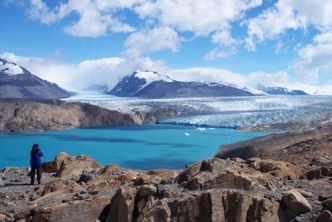
left: The Upsala glacier from another angle.
The guide showed pictures taken 30 years ago and we could see the huge distance the foot had receded and how a new lake had been formed.
Norma took the optional horse ride. That was free. They only had six horses and only one was left. She was able to take it and had a great time riding the horse, crossing three rivers in the process, including one big one. 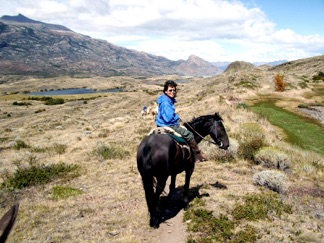
right: Horse riding on the Estancia Cristina
It was close to three before we had lunch; a sumptuous meal of grilled cordero (lamb), salads, and postres. Argentines love postres. The ranch is actually still a good half mile from the landing place for the boat and we had to walk that distance back again. But as we boarded our boat for our journey back, almost all of the employees were there at the dock to wave us goodbye. These were the park rangers of the Argentine National Park Service, 22-28 years of age, of both sexes, living there during the whole summer as guides for the visitors. They were really nice people. And our group consisted of only about 35 people.
We were tired when we came back to the Posada, but we decided to go and have a late dinner anyway at the La Posta. Came in at 11:15 and we were still served with a smile. Wonderful service. Wonderful food.
Ushuaia
The flight from El Calafate to Ushuaia took about an hour. This time we had to pay the departure tax, 18 pesos/person, before boarding the plane. There were quite a number of older passengers on the flight. The weather forecast for Ushuaia was for 50 % chance of rain.
Ushaia is a port on the Beagle Channel, where cruise ships stop on their journey from the Pacific to the Atlantic and vv. The city prides itself as being the most southern city in the world. It is El Fin del Mundo, the End of The World. Port Williams in Chile is actually further south, but this is a military establishment, so the Argentines don’t count that as a bona fide town. Ushuaia used to be a penal colony but when the colony was abolished, the Government decided to keep the city alive by giving a 20 year tax holidays to manufacturing firms willing to locate in the area. And many firms, such as Grundig, took up on the offer and many people came to this place to “work for a few years” to earn good wages. So many of the houses were built to last for only a few years. But most stayed. And the houses had to be fixed. The tax holiday is now over and these companies have left the city because it was just too expensive to ship the raw materials in and the finished products out. The buildings they left behind are now used by the city for civic purposes. Now the city has to survive on tourism. So everything which can be converted into a tourist attraction is done so.
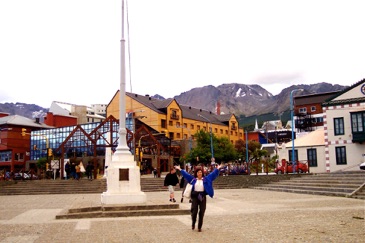
left: Port area of Ushuaia.
When I was here earlier our boat packed in 40 gallons of chocolate ice cream. I think there were fewer than 40 passengers + crew on board. We had ice cream at every conceivable occasion.
To get from the Atlantic Ocean to the Pacific you could go around Cape Horn. This voyage exposes the traveler to rough seas and heavy winds. In 1520 Magellan looked for and discovered a shortcut, the Straits which now bear his name, connecting the two oceans. But the Strait of Magellan is narrow and shallow in many places and therefore unfit for larger vessels. More to the south is the Beagle Channel, which is 150 miles long and 3 miles wide at its narrowest point, now used by the cruise ships as they go from the Pacific to the Atlantic and v.v. The channel is named after the ship HMS Beagle, on which Charles Darwin explored the area in the 19th century.
Somebody from the travel agency was there to meet us and to drop us off at Tango B&B. This B&B is operated by Raul and Cristina de Luca, the parents of our travel agent, Paola de Luca. They had just converted 3 rooms of their 5-bedroom house for guests. It was a private house and we were given a nice room with our own bathroom and toilet en suite. It was probably the master bedroom. Paola’s sister, Sabrina, was there also. She was there on vacation. She is 23 and a student at the University of BA studying philosophy, hoping to get a grant in the future to do graduate or postdoc research in Berlin. Both Raul and Cristina teach Political Science at the local university.
It was an invigorating 13-14 blocks to get to the center of the city, not that far and it took about a pleasant 30 minutes. The weather was a nice 60 degrees and it was cloudy but dry. The city does not have much character. 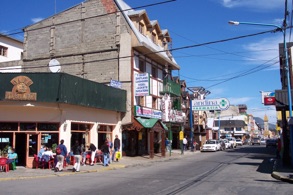
right: Downtown Ushuaia.
We had dinner at the Cantina Fueguina on San Martin, the main street. We ordered cebolla, or king crab, which seemed to be the specialty of the region, because everywhere you see pictures of this huge crab. We ordered the cebolla a la casa, and got a mixture of crab meat in a sauce. Tasted OK, but really not worth the price. What we wanted was the crab itself, freshly cooked preferably, where we could pick out the meat. Rather disappointing, but the 2004 San Felipe Chardonnay was good, as expected. We took a taxi back home. The fare was 2.4 pesos, less than $1.=
We complained about the crab to our hosts and were advised to order the cebolla au naturel . We did so the next day and we were served peeled crab from their refrigerator. No freshly cooked crab. It tasted as if it had been in the refrigerator for some time; it was stringy and tasteless. But we were also served with a couple of sauces; to cover the refrigerator smell, I suppose. Complained again to our hosts and then he suddenly realized that crab was out of season and so all they had was frozen or refrigerated crab. Crab is expensive and the locals have found out long ago it wasn’t worth the money to eat it. So they had to push it on the unsuspecting tourists to get rid of their stock. You can get better tasting crab for less money in the freezer section of Safeway in the USA.
Tierra del Fuego National Park
The next day was unusually nice for Ushaia. Sunshine, dry, and warm; in the 70’s. The locals were amazed. We told them we had taken our weather along from sunny California. We were picked up at 8:15 for our tour to the Tierra del Fuego National Park. There were about 40 tourists in the bus but when the guide asked who wanted English, only two couples put up their hands. We were one of them. The other pair belonged to a Chinese couple from Taiwan, whose English was not too good but whose Spanish was non-existent.
Barbara, the tour guide, smoothly went back and fro between English and Spanish during the tour. On the tour the next day, we also had a full bus and we were the only people asking for the tour guide to explain proceedings in English. He put us in the front seats, so he could give us the tour in English face to face, and then switch to his microphone to give the same story to the group in Spanish. But it is clear that not too many foreign tourists come here. They do come on the cruise ships because Ushuaia is a port of call, and they come here as the jumping point for their trip to Antarctica. As a matter of fact, if you have time and want to go to Antarctica it is quite possible to join a ship here on the last moment for a good discounted price.
The Park is in the Southwest corner of Tierra del Fuego and comprises 63,000 hectares.. A interesting feature of the park are their peat bogs. They are accumulations of dead plant material, mostly Sphagnum mosses, reeds, and grasses. Low temperatures, acid waters, and the absence of bacteria in these regions, prevent the decomposition of this material. Under compression by the weight of the upper layers, peat is formed anaerobically. This peat layer is fragile and grows only at a rate of around 1 mm/year, so 25 years are needed to add just an inch to the peat layer. Outside the park some of the material is mined, dried (about 70 % moisture originally) and used as high-end fertilizer.
The most prevalent tree is the Lenga, or southern beech. Many of these trees have large whorls on their trunks. The tree is attacked by a fungus, and the tree exudes a sap to kill the fungus. The sap coagulates forming a small whorl. The next year fungus attacks the tree at exactly the same spot. More sap is produced and the whorl grows.
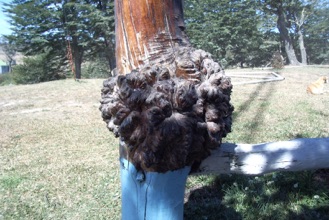
left: Large whorl on the trunk of a beech tree.
Rabbits, beavers, musk rats, and the Patagonian red fox were introduced into this area a few decades ago. As can be expected they have changed the environment drastically and not necessarily for the better. Especially the beavers are thriving. We visited a big beaver dam which is a standard item on the tour. I looked at the pictures I took 9 years ago, and there was not much difference.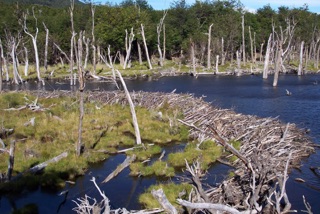
right: A huge beaver dam. It had not changed much since I last saw it nine years ago.
We also drove past the world’s most southern golf course. It is pretty good looking now. Nine years ago it was rather desolate and they said the golf course was built only because Chile had one a little bit further north, which was the most southern golf course at that time. In September of last year we were in Ja∂arsvöllur, in Iceland, which is the most Northern golf course in the world, just 60 miles away from the Arctic Circle. We should have hit a golf ball all the way from north to south and establish a record of sorts. Don’t know about the oceans in between though.
In the park is also the end of Route 3 of the Pan American Highway. The other end is in Alaska, 17,848 km away, not sure exactly where. We couldn’t find it when we were in Alaska.
Then we took El Tren de Fin del Mundo, the train at the end of the world. It is a cute train for the tourist, and it was built on the tracks of the old train which brought the convicts to this area to chop down trees. In the fields you can still see the stumps of the trees they cut down half a century ago. There is little deterioration because of the absence of bacteria.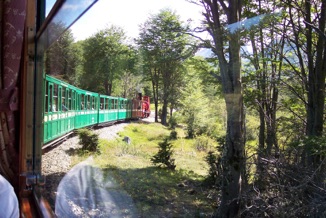
right: El Tren de Fin del Mundo
We were back in the city by 2 p.m. At 3:00 there was a tour on the Beagle Channel offered by Catamaranes Patagonia Argentina. For an additional fee of 50 pesos/person we took the extended tour which would bring us also to Isla Martillo, where there is a huge colony of Magellan penguins.
The Beagle Channel.
The catamaran Ana B. was large, comfortable, and stable. There was food service on board. The boat left punctually at 3 p.m.. We noticed that in Argentina people are much more punctual than in the USA. We sailed past the Islas de los Pajaros, where we stopped to look at the hundreds of cormorants on the island. 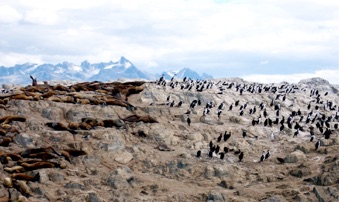
left: Cormorants and sea lions sharing space on an island in the Channel.
On the Isla de Los Lobos, there were cormorants on one side and sea lions on the other side. They share the space.
Then past the light house, El Faro Les Eclaireurs, the symbol used in the tourist brochures. We passed the Estancia Harberton, established by Harberton to create employment for the indigenous population, the Yamani Indians. Isla Martillo, our final destination, was still further ahead. There is a huge rookery of Magellan penguins. The boat parked its nose on the sandy shore for us to observe the penguins from closer by.
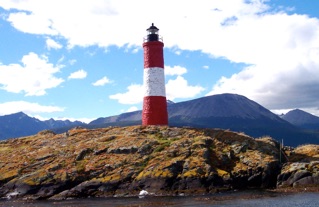
right: The signature lighthouse of Ushuaia.
That was the furthest point of our trip and the boat turned back. It was a long trip, because we didn’t get back until around 9 p.m. On the boat we spoke to a young American who is spending his vacation her trekking the mountains in the area. It is easy to find trekking partners, he said, here in the youth hostels. And he thought the trekking over the mountains here was awesome.
Dinner was at the Cantina Figuenia again for their special shellfish dish for two, It tasted as if it came from a frozen package, jazzed up in a tomato sauce. Maybe the package had already exceeded the pull date, because the meat was tough. But the waiters were very nice. We have learned long ago that a seafood restaurant close to a harbor does not necessarily serve fresh seafood from the waters close by. It is cheaper to get your supplies frozen from your supplier.
There is one good restaurant in Ushuaia, Tia Elvira on the harbor on Av Maipu 349. Yes, the prices are higher, the waiters are formal and rather cool, but the food is excellent. We were there twice and had the merzula (black hake). The taste of the grilled fish was marvelous.
Lake Escondido
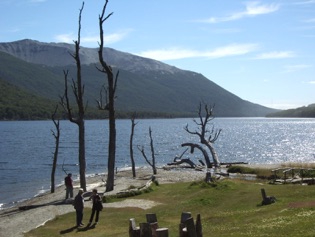
left: Lake Escondido from Hosteria Pretel.
We did stop at a dog farm where they breed Siberian and Alaskan huskies to pull sleds in the winter. They claim that some of their huskies have competed in the Iditarod, the prestigious dog sled race in Alaska, all the way North. The Siberian husky is bigger and stronger; the Alaskan husky is smaller and faster. You can just walk around the grounds and pet the dogs. They are all very friendly dogs.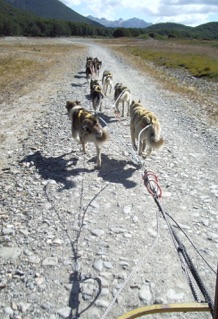
right: Dog sled going at breakneck speeds
In the summer they pull a wheeled sled around a 2 mile round track and the adventurous tourist can sit on the wheeled sled and be pulled on this sled at breakneck speed for 20 pesos/ride.
That evening we were back early and our host, Raul de Luca entertained us on his accordion accompanied by his synthesizer, playing for us tango pieces as it had developed over the last 5 decades. Marvelous. The tango is not necessarily determined by its beat, but by its expression of a way of life; a bit sad and melancholy.
Ushuaia is a small town so everybody knows everybody. But Raul de Luca is also a celebrity in town for another reason. Last year he organized, directed, and hosted a one-hour show airing monthly on the local TV station. He had local guests and groups come over for talk shows, musical performance, etc., and as host he would be needling the local politicians for what they were doing or not doing. That made him a popular hero for the masses, but the TV station, which is run by the Government, shut him out after a while. Hey, you don’t want anarchist on the air polluting the minds of your children, do you. I can still see him chuckling as he tells us these stories
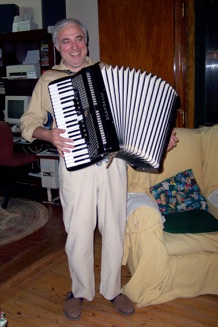
left: Raul de Luca on his accordion
The last day in Ushaia we went to look at the local museums. There is the Museo del Fin del Mundo, where people come in to have their passport, (yes, their passport) stamped with a stamp showing you have been to the end of the world. There was another museum, this one devoted to the Yamani Indians, the indigenous population who used to live here in simple little shelters made from wood, boughs, and branches of trees. They were hunters-gatherers and even in this barren and inhospitable climate they used to move around completely naked, with just a thin layer of animal fat on their bodies for protection. Clothing, apparently, was more of a hindrance than an asset. If it rained, it would get wet and they would get chilled. And they didn’t have any gas or electric dryers in their huts. So clothing would stay damp. They were adept in keeping a little fire burning at all times.
There are now only a few dozen of these Indians left. Except for one woman, everybody else had intermarried.
The Glaciar Martial.
We also went to have a look at the Glaciar Martial. To get to this glacier, you take a taxi to the funicular station about a mile behind the Hotel del Glaciar, a large green-roofed building in the hills you can see from everywhere.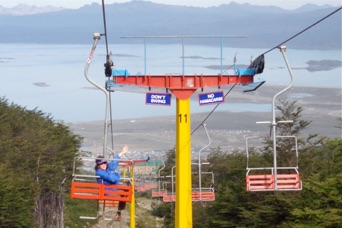 From there you take the chair lift up and from the top station it is about a mile to get to the foot of the glacier.
left: The chair lift to the glacier. The Beagle Channel is in the background.
It is a nice, easy hike and you can walk up along the stream or through the forest. There are very nice views of the glacier in front of you. Looking back you see the Beagle Channel and Ushuaia below you. I think the foot of the glacier must have receded about 100 feet since I was there nine years ago. Back from the glacier you can relax at the cafe at the top of the funicular with a sandwich and a glass of beer.
Even though this sound like a remote location, there are always taxis available at the foot of the funicular from new people arriving there. Otherwise, the nice cashier who sells the tickets to the funicular is more than glad to call a taxi for you, so you can get back to town.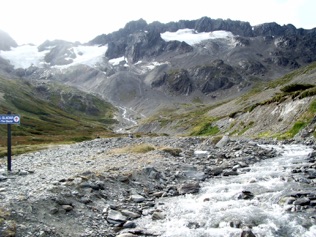
right: Walk to the Martial Glacier above Ushuaia
Before you get carried away too much about Ushuaia, there was the following posting by Bruce Burns in Frommer’s Travel Talk:
“Wow, I was in Ushuaia in January and I could not wait to leave. I found nothing to recommend it, although I didn't stay at the Tango B&B. I did take the incredibly boring prison-train ride (where they told us, oh, maybe 95 times, that we were riding on the very same train trail as the original prisoners. I know how they felt.), and the very hot (as in shed some of those sweaters they told us to wear) catamaran ride to see the lighthouse and sea lions.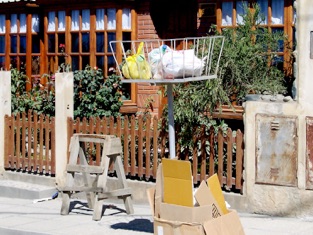 Tempers rose and fights broke out among the very old people on the trip (That was the highlight of the trip). And we trekked through a park. Gawd, it was awful.”
left: As a followup, the picture on the left shows how the people get rid of their garbage. They pack it in plastic bag and put them in baskets high above the ground for the garbage pickup.
The plane left Ushuaia late in the afternoon. There was a departure tax of 13 pesos/person and we came into BA just after midnight. We checked into the Pestana Hotel. Had a very nice breakfast the next day and explored the city some more that day. Our plane home left that evening from Ezeiza airport. Security was strict, since we were flying American Airlines back to the USA. There was a departure tax; this one in US dollars; $18/per person. They accept US$, pesos or Mastercard. No American Express.
V: El Calefate and Ushuaia