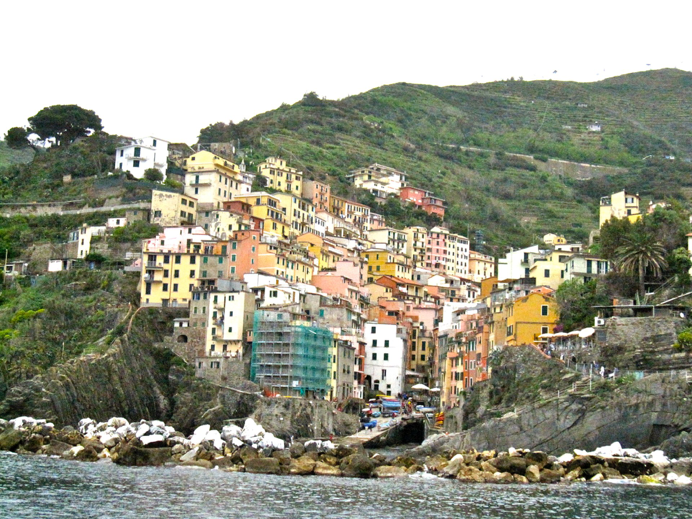
Riomaggiore

I: Riomaggiore
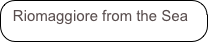
right: View of Riomaggiore from the Santuario della Madonna de Montenero. Note the steep hilly terrain and, if you look closely, you can see the terraces where vineyards are located on the steep mountain behind the town. On that same mountain you can also see a road going around the mountain not far above the water. This is the Via dell’Amore linking Riomaggiore with Manarola. This is also the beginning of the “blue” path linking these 5 villages.
1: L’Arcobalena Affitacamere.
We drove up to Riomaggiore from la Spezia through winding roads in the mountains to get to l’Arcobalena (which means rainbow) B&B, which was located at the top of the town. This is in the hills on the right, if look at the picture above. That is also how far you can get with your car, because traffic into the town is limited to special vehicles. Adjacent to the B&B, there is a large parking place, charging €22 per day for parking. From there it is a steep walk down to main road, the Via Colombo, to the village, the harbor, and the train station.
If you had come from La Spezia with the train, you will have an exceptionally hard time climbing up from the train station to the B&B, pulling your luggage behind you. There are no taxis. You can catch the bus, if you know when and where it leaves to get to the top of town, where l’Arcobaleno is located. And maybe you can also just faint from exhaustion. Because besides the bus, the only other vehicle allowed down there is the city ambulance.
An official Tourist Information Office was just around the corner of the B&B, which we thought would be very helpful, but this turned out to be a major dud. The clerk on duty was always only interested in her computer screen. She was not helpful at all, on the edge of being surly, just giving minimal, bored answers to our questions, and looking relieved when we left. We were there twice, both times with the same results. You will not see any lines of people waiting for help; most of them probably just left.
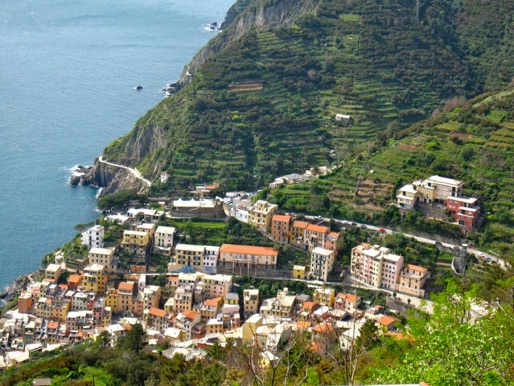
left: Lunch on the patio of l’Arcobaleno; our room is behind the green doors.
The B&B had a private garage, which was a plus. l’Arcobaleno was very pleasant place to stay; Patrizia, the owner was very helpful and informative. Lily, her old dog, did what old dogs do, which is just sleep a lot. We had a nice, airy, and clean room, about 200 sq feet large, adjoining a 100 sq ft semiprivate patio with table and 3 chairs. Breakfast was in the refrigerator and on the table; large selection of breads and biscuits, juice, bottled water, yoghurt, milk and a impressive machine which could either make hot water or brew various kinds of coffee, such as Caffè Americano, Espresso, Cappuccino, Macchiato and I don’t know what else. In Italy where drinking coffee is an art and an obsession, this is important.
2: Riomaggiore.
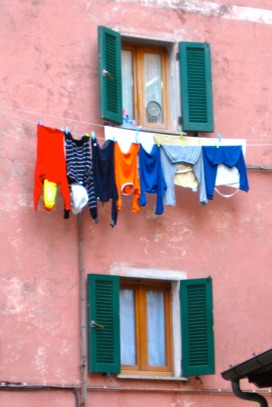
Even though the sun was not very bright that day, it is wonderful to see all the colors of the village. The walls of the houses are painted in pleasant pastel colors, but I don’t know whether the laundry was specially hung there for the benefit of the tourists. This wall was fronting the main street.
right: Laundry in the late afternoon.
It is a pretty steep walk down from l’Arcobalena, and an equally steep walk uphill when we want to go back home. This is an important walk, because most of the eating places are in the town; so is the railroad station as well as the harbor, important if you wish to go and visit the other towns in the area.
Because some of the other streets are not as steep as the main drag, many houses here have two entrances; one at the street level of the lower street; the other one at the level of the higher street.
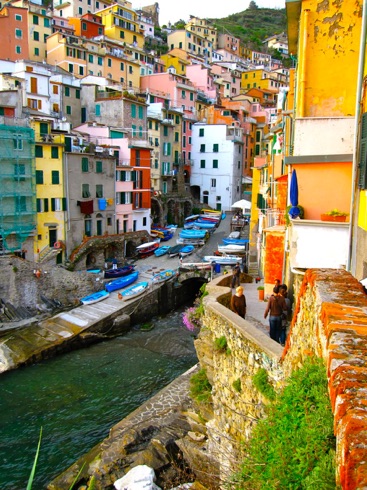
So the first thing you go is to get the schedule of the bus which runs from the middle of downtown way below to LaVaccio, which is the area where l’Arcobalena is located. Going down is free, but going up is €1.00 per person, for which the driver will laboriously write you out a ticket. Yes, I am not kidding; he writes out a ticket with his ballpoint pen. Certainly more personal than just giving you an impersonal printed ticket from a stack.
left: The upper part of the harbor of Riomaggiore. The lower part, facing the sea, is not that large either and strewn with rocks, making access to larger boats impossible. See the picture of the ferry on the next page.
3: La Grottino.
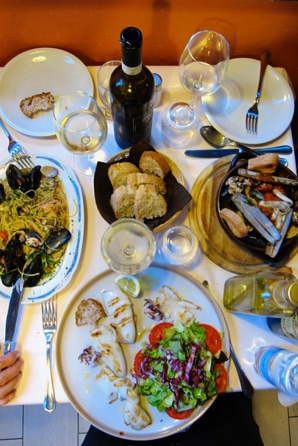
We stayed 5 nights in Riomaggiore and had dinner in various venues. But we thought La Grottino was the best.
right: Dinner at La Grottino. On the left is a shellfish spaghetti,(€12), below is a grilled calamari steak plate,(€14) and on the right the shellfish soup.(€9). The wine was a very good local white wine, Ombra de la Luna, for €18. The tab for the dinner was around €60, and yes, they did have a couvert charge.
The hardest part of the dinner is of course the walk uphill. Unless we had an early dinner so we could catch the last bus leaving at 7:40 p.m. from the center of town.
At a same elevation as l’Arcobalena on the Via de Gasperi is the Restaurant Ripa, or better, call it Restaurant Ripoff. Ank dropped there for just a cup of soup and a cup of coffee in the late morning and the bill came to €13. They charged her the full couvert, just for this one cup of soup. Well the place was attractive because you don’t have to walk downhill to get there and then have to walk uphill to get back home.
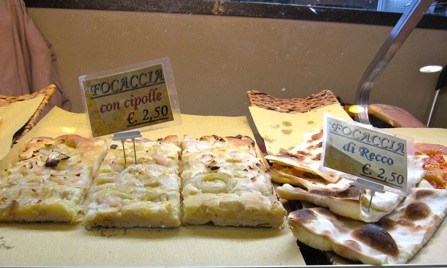
left: Try the focaccias.
But there are of course other venues, where you can get food at more economical levels. There are lots of places where it is quite OK to eat just outside the establishment.
Try the bruchetas; they are usually very good; they come with various dressings and toppings. And don’t overlook the focaccia al formaggio. Or focaccia with other dressings.
4: La Via dell’Amore
or the Road of Love is the most well-known walking path in Cinque Terre, just about 1 km in length, linking Riomaggiore with neighboring Manarola. It is flat and easy to walk on, it is even wheelchair accessible, and it has superb views of the surroundings. On the steep craggy hills, there are flowers lining the road and if the wind is blowing, you may even get some spray from the ocean. This path is part of the Sentiero Azzuro or the Blue Trail, a path connecting the five villages. This path was created during the construction of the railroad tracks as a necessary adjunct for access.
Unfortunately, just before we arrived, some boulders rolled on the path, so the Via del’Amore was closed to the public. Asked when we ask when we can expect the Via to reopen, the usual answer is a shrug: “this is Italy, and there is probably a commission to appoint another commission to determine whose fault it is, who is going to do the repair, who is paying for the repair and who will be responsible for preventing a reoccurrence.” This will take time and don’t hold your breath. The tourists will come anyway.
Anyway, to get to the train station in Riomaggiore from the old town, you have to walk through a long tunnel. At the end of the tunnel is the train station and not far above it is the entrance to the Via dell’Amore.
5: Andrea Pecunia’s Wine Tour
If you have the time, this is something you don’t want to miss. It is a completely different experience than a visit to a standard, faceless, commercial winery, each doing its tired best to impress and awe the visitor. Andrea owns a small vineyard on the steep hills close to Riomaggiore, painstakingly chipped out of the rocky hillsides years ago. Retaining walls, 3-6 feet high are used to stabilize the ground, but also to reflect and to retain the heat from the sun for the vines. The vineyard is actually right alongside the narrow walking path from the SP 370 highway to the Santuario della Madonna di Montenero.
The wines of this region have been known since antiquity. Petrarca mentions them, as well as Dante and Bocaccio.
Small, with only around 1000 vines, he cultivates his orchard single-handedly, mostly by hand, also because the terrain is not suitable for mechanical aids. The only thing mechanical in the area is that every few hundred yards there is a track for a trolley to go from the top of the mountain to the highway several hundred feet below to transport the harvest to a more accessible place, where a motorized vehicle can pick it up for transport to the winery. The is a community trolley, used by several winegrowers in the vicinity.
And there is obviously a lot of climbing involved. Only during the harvesting season does Andrea try, not always successfully, to get an intern to help him and who does not mind hard work with very little pay. His usual source is the local University, which does have a wine growing class. He grows a mixture of Bosco, Vermentino, and Albarola vines, which are the usual vines in this region.
For the tour he charges €39 per person, minimum of 3 persons, and the tour will take 3-4 hours. He will meet you at the Banca Carige in the center of Riomaggiore or at the information center at the top of the town. With three guests, you are in luck, because he has a small car with which he can drive you to the bottom of the hill where his vineyard is located. If there are more guests, you will all take the bus. But then you have to walk back to Riomaggiore, which is mostly downhill, because his cellar is in the town of Riomaggiore, but which I estimate is still about 2-3 miles away. The bus only runs twice a day from town to the entrance of the Santuario, which also happens to be the entrance to his vineyard. With three guests, he can drive you there and then back to town. If you don’t like to walk that far and you have a car, you can suggest you drive. The tour is in English, French, or Italian.
The bus stop is also the start of the path to the Santuario. Halfway up the hill you will pass the vineyard of Andrea. He is just a one-person operator and somebody wrote a glowing website for him (it doesn’t quite sound like him; he is much more modest) where you can make reservations, but you can also contact him at Andrea.Pecunia@virgilio.it and save him the agency’s fees, or call him at 39 3 2870 4791. He speaks English.
From the bottom of the hill you walk up a steep path to his vineyard, where he will explain how he grows his vines. From there you have a marvelous view of the surroundings and the Ligurian Sea and wonder why so many people still bother to cultivate these wines on this difficult terrain. He says he loves the challenge of almost singlehandedly making delightful wines responsibly. He still uses a copper-sulfur spray for his plants, avoiding the synthetic insecticides used in most other vineyards. Neither does he use chemicals to control the grass and weeds around his plants. At ground level he encloses the stems of the vines with a short section of plastic tubing. To remove the undesired vegetation he uses a standard Weedeater, which uses a fast rotating plastic string to cut the weeds. The plastic tubes around the vines are there to protect the vines from unintentional damage during this operation. Yes, there is a lot of hard work in this vineyard, especially if you 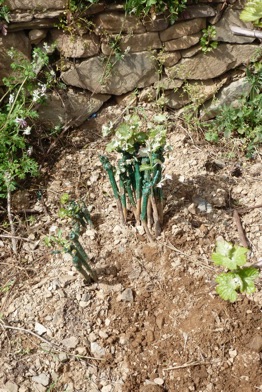 consider the steep slopes and the fact that he is all by himself to do the work.
left: These are the shoots he purchases for his vineyard. They actually consist of three components grafted on top of each other. The roots are from the USA because they are fungus-resistant; above it is the general grape vine, and on the top is grafted the variety of the grape.
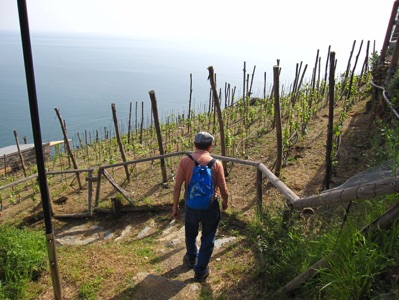
below: There is a superb view of the sea and the surroundings from the vineyard. This is the path from the highway to the Santuario with the vineyard of Andrea to the right.
Because of the terrain, the vines are also often attached to a wire canopy and the worker can then work from below to maintain the vines and to harvest the grapes. Even than the worker often still has to work on his knees. This is often the case for the areas close to the stone retaining walls. There is a picture on the section II of this travelogue, showing the vines growing on a canopy.
From his vineyard is a short 10 minute walk up to the Santuario, located up on a hill where you will find a 14th century church and where you have an amazing 360 degrees view of the surrounding mountains, villages in the distance, and the blue sea below. From the Santuario there is a path to Riomaggiore, which will take you about one hour to traverse, almost all of it downhill.
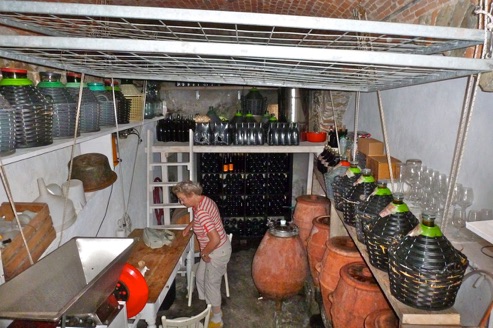
left: This is Andrea Pecunia’s winery. It is substantially smaller than the Romney garage.
Then Andrea will take you back to Riomaggiore to show you his winery. You will be surprised because what you will see is the tiniest commercial winery ever. It is a cellar about 8’ x 30’, where he takes his harvest and removes the stems, then presses his grapes, after which he ferments them in the same type unglazed earthenware jars as the ancients have done thousands of years ago. Then he bottles his wine, and affixes his labels, and stores them in the back shelf ready for sale. And all of this is done by hand.
Stems and leaves are removed in the unit on the lower left. The earthenware jars are where the fermentation takes place. Up near the ceiling the racks are visible where the grapes are hung to dry.
He makes the two most important wines of the region, the white Cinque Terre wine and the Sciacchetrà. For this he combines his grapes, a blend of the three varieties described earlier, of which at least 60 % is Bosco, and separates them in two batches. The lower quality grapes are processed immediately. This will result in the “white” Cinque Terre wine, which is actually still somewhat pinkish because of the process. It has a delicate bouquet and a fine finish. The minimum alcohol content is 11 %. He sells this wine for €15/bottle of which 21 % is the Value Added Tax. So he doesn’t pocket very much for himself.
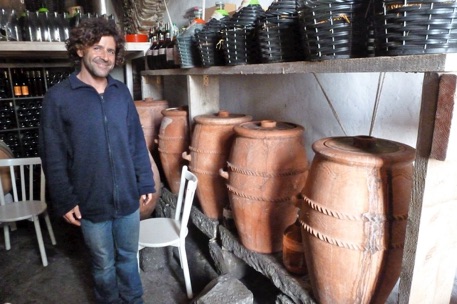
right: Andrea Pecunia, the winegrower, next to his terracotta jars where he ferments his wines.
The better quality grapes are hung up on the rafters to dry and to allow the sugars to develop and concentrate. After some weeks, they have lost a lot of moisture and are almost like raisins. In October they are then processed into the more headier amber-colored nectar, also known as Sciacchetrà, which I guess is rather similar to a German Trockenbeerenauslese. These wines from his production come in smaller bottles of around 350 ml each and he retails them for €35/bottle. It is an excellent dessert wine with an alcohol concentration of around 17 %. The usual price of these wines in the wineshops is round €40. Not cheap, but there is a lot of work involved. And the yield is also much smaller, because the grapes have lost lot of moisture during the drying process.
His total production of both wines is only 1000 bottles/year, which is barely enough to make even a tenuous living. You wonder why people still do this; he says he does this because he loves the challenge of making a superb wine. He does these tours to supplement his income, but he nevertheless pours out generous portions of both wines for tasting. Very nice guy. But he is never going to be rich in this business.
6: The Santuario della madonna di Montenero.
This is a place high up on the hills east of Riomaggiore with an astounding view of the surroundings. Just read the comments on Tripadvisor. The azure Ligurian Sea will shimmer in the distance for you; Riomaggiore is far below you, and there are vineyards everywhere. On the top of this section on Riomaggiore are pictures of the town from the sea and from the Santuario.
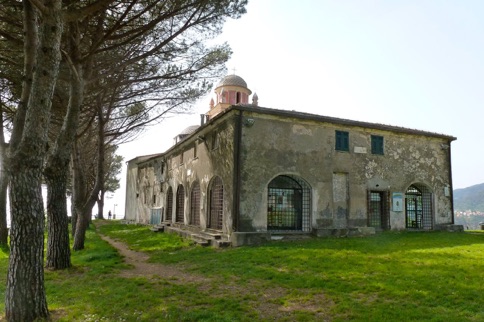
left: The 14th century Santuario della Madonna di Montenero on a large grassy field.
But for the unwary tourist the place is not that easy to find, even though the locals say it is straightforward to get there. Well, it is easy once you know where it is; not before. There is a path from the top of Riomaggiore, close to l’Arcobalena B&B, which will take you there, but it is a good hour’s walk uphill, so this option is not that attractive to the majority of us. From Riomaggiore there is also bus, which will do the climbing for you and take you to a point on the road above Riomaggiore. But from here, it is still a walk for 10-15 minutes to get to your destination. The problem is that the bus only goes there twice a day and so, if you go by bus, you have to walk down to Riomaggiore, which is maybe a walk of an hour, but all of it downhill. You can go on the walking trail, or you can walk back down to the bus stop and from there walk down on the main, paved road.
The third option is to take Andrea’s wine tour, and he will take you there from his vineyard. And from there it is only 5-10 minutes walking to get to the Santuario. The challenge is that you have to be part of a party of three, because the tour minimum is three and he only has a small car, which can only take three passengers. Less than three, there is no tour. More than three, you need to take the bus; or you can suggest you use your own car and follow him.
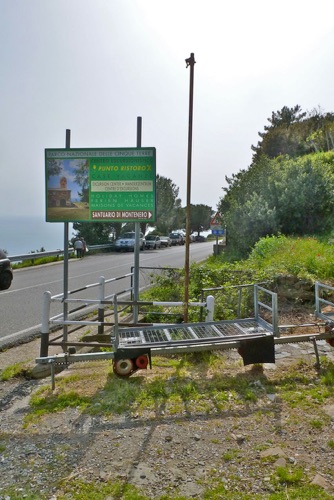
The fourth option is to take your own car and drive up to find the start of the path. Look out for the sign shown in the picture on the right:
right: Sign showing entrance to the Sanctuary. You still have to walk for 10-15 minutes to get to your destination. The cart shown is on a monorail going all the way up the mountain. These carts are used to haul the grapes down from the vineyards to the road, were a truck or car can take them to the winery.
This is also the start of the path to Andrea’s vineyards. Once you are up there, there is a large grassy field with the 14th century church in the middle.