Hiroshima and the Inland Sea
Hiroshima, mon amour
By now most of the members of the group had left for home and only five of us remained to enjoy our extended vacation. A Shinkansen took us from Kyoto to Hiroshima in about 90 minutes. There is not much space for luggage in these trains, so we had to survive the next three days on the contents of our carry-ons. Honestly, it was easier than we thought possible. It just reinforces my belief that we usually lug too much stuff on our vacations. Our big bags were shipped to Kansai airport, where they would be waiting for us to take them home with us.
.
The Hotel New Hiroden in Hiroshima was just a 5-minute walk from the station. After depositing our luggage there and after lunch in the station, we left for the A-Bomb Museum and the Peace Memorial Park.
Hiroshima is, of course, known that on August 6, 1945, the first nuclear bomb was dropped here, killing as many as 140,000 persons, and effectively ending WW II. The city was almost completely demolished in the blast, and what you now see is an overgrown suburb, rebuilt city, modern but devoid of any character. 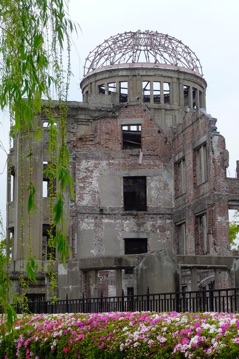 The Park is built in the open space created by the explosion, but they left the skeletal ruins of building, which was located closest to the hypocenter of the explosion, intact. These ruins, reinforced to keep them standing, are a stark reminder of that catastrophe.
left: The reinforced skeletal remains of the A-Bomb Dome
In the Park there are memorials, monuments, a museum, and lecture halls. It is a nirvana for activists. There are memorials for about everything related to the Bomb and to Peace. Besides the A-Bomb Dome, there is the Children’s Peace Monument, the Atomic Bomb Memorial Mound, a Cenotaph for Korean Victims, a large Memorial Cenotaph. a Peace Flame, a Peace Bell, a Pond of Peace, a Peace Fountain, Monument to the Employees of the Hiroshima Post Office, Monument to the A-Bombed Teachers and Students of National Elementary Schools, and so on and on. One of these days they will install a Memorial Monument for A-Bombed Pets of Children from Sex-Dysfunctional Parents.
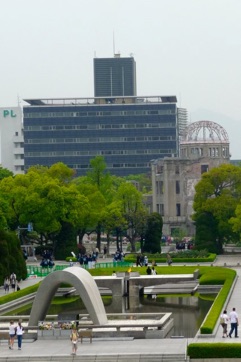
right: The Peace Memorial park, as seen from the Museum, with the large Memorial Cenotaph in the foreground, the Peace Flame receptacle in the middle and in the Distance the A-Bomb Dome.
Then there is the A-Bomb Museum, with a display of the history of the atomic bomb and a display of the victims and other material conveying the horror of the event. There is actually nothing new in what was shown, but the manner in which the material is presented is extremely important. History can be viewed from different sides, and in a setting of grief, anger, and pain over the bombing, the possible interpretation on what is shown can be easily influenced by how it is presented. With a million people walking by annually, this is a major opportunity to sway people to your way of thinking.
Wikipedia claims that the Peace Memorial Museum presents a very fair view of the atomic bombing, because it presents the Japanese military actions in a negative light and acknowledges the thousands of Korean slaves, who were also victims of the bombing. Well, after seeing the display yourself, you realize that the Wikipedia piece must have been written by someone employed by the museum.
Nothing is said about the Rape of Nanjing when, in December 1937, the Imperial Japanese Army raped and killed some 300,000 people, or more than twice the people killed in the atomic blast. During that six-week period thousands of women and young girls were gang-raped and killed afterwards, often by a bayonet, bamboo stick, or other objects thrust into their vaginas.
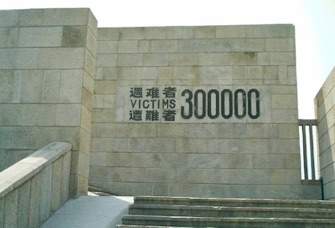
In one of the killing fields of Nanjing there is now a simple memorial to the dead, with the number 300,000.
left: the simple memorial in Nanjing with the number 300,000.
In all wars people get killed and women get raped, but it is the magnitude of the suffering of these two events that require remembrance.
As for fairness in reporting, assume that you note that your neighbor’s front door is black and you report it as such. Your neighbor, who feels that a black door reflects poorly on him, will then (a) claim that the door is only gray, and not black, (b) you are not to be trusted, because you subscribe to the Washington Post, and/or (c) there was never a black door, such as “The Holocaust never happened”. You want to stay friends with your neighbor and so you modify your report and you then say that the door is painted in a “classical” color. Which can be black, but it can also be red, if the neighbor thinks society will look better on him that way. Well, that is what you call “fair” reporting. It says everything and nothing and you can deduce what you want.
So, with all this “fair” reporting, what does the average Japanese belief after seeing the exhibit in the A-Bomb Museum. The following are some of the views I heard.
(a) The US Government dropped the bomb, because they had already spent so many billions in research. They had to drop the bomb to justify these large expenditures to the US public.
(b) Because the US Government wanted to study the effect of nuclear radiation on human beings, they dropped the bomb.
(c) There was no reason for the US to drop the bomb. Japan was already at its last gasp and would have surrendered soon anyway.
(d) Japan had to go to war, because their expanding economy was being squeezed by other nations, and their sources of raw materials were being blocked.
Going back to the displays, you find to your amazement that. because of the ambiguous wordings, with a little stretch of convoluted thinking and maybe with a different cultural background, you could come to these same conclusions. (a) The US Government did spend a lot of research money on developing the bomb and there were indeed objections raised over the large amount of money spent. To conclude that this was a reason for dropping a bomb is a jump in hyperspace, but apparently quite believable in Japanese eyes. (b) The US had a large program to determine the effect of radiation on the human body, both before, during and after the bombing. Again, to conclude that this was a reason for dropping a bomb is another jump in hyperspace, but apparently also quite believable in Japanese eyes. Their military would have done that. (c) The display makes a major point of reporting the hardships in Japan at the end of the war, with rationing, shortages and many casualties, including many friends, uncles, and other close of kin. But nothing was mentioned about the fierce resistance of the Japanese in the islands leading to Japan and that the US estimated it would have lost some 100,000 soldiers, and Japan would sustain a huge number of civilian casualties, had the Allies tried to invade the Japanese mainlands. The atomic bomb actually reduced the number of possible casualties on both sides. (d) Where have I heard this justification before?
The monument undoubtedly makes a strong point about the horrors of war, just as the museum in Pompeii makes a strong point about the horrors of volcanic eruptions. The Peace Park will, therefore, deter humanity from using nuclear weapons, just as the museum in Pompeii will deter volcanoes from erupting.
Somehow I feel that this whole circus is just a huge ploy to lure tourists. Because it doesn’t really change the mind of the world leaders on what is right and what is wrong. Maybe Japan will ban nuclear weapons, because the Peace Park is here, but I am not sure any other country will. If a country already has nuclear weapons, it will definitely deter others from acquiring nuclear capabilities. If a country has none, it will try to get nuclear armaments by hook and by crook to get parity in the world chess game of power.
There is a scrapbook at the exit of the museum where visitors can write comments. Most of them are the usual platitudes about World Peace and the horrors of nuclear war. So it was interesting but not too surprising, when I read the last entry;
“ .... It is clear from this exhibit that we should tell the fundamentalist Islamic leaders about the horrors of the atomic bomb ..... “,
and it was signed by somebody from Israel. Well, I have a hard time considering this a message to the Governments of the World, including Israel, to banish their nuclear arsenals. To me it looks more like a threat to the fundamentalist Islamic leaders. “You behave and do what we want you to do, otherwise the horrors of nuclear war will be showered upon you.”
So much for World Peace.
Miyajima
O-Torii and the Itsukushima Shrine.
In the morning we dutifully trooped to the railroad station where we boarded a train to Miyagumi-guchi station, a trip of about 30 minutes. We then took the ferry to Miyagumi, an island in the Inland Sea. There were two competing ferries next to each other. Same fare, so one takes the ferry which was going to leave the soonest. The crossing takes about 10 minutes.
Miyajima is both a tourist destination as well as a “sacred” island. Deer and monkeys roam freely, and the trees may not be cut for lumber. It is mountainous, sparsely settled and, surprisingly, not overrun at all by tourists. The island is only 12 sq miles, and yet it still retains its serenity. One of the drawbacks of living on a sacred island is that you cannot soil it with your dirty underwear. If you stay there in a hotel or ryokan, you have to send your dirty laundry to the mainland.
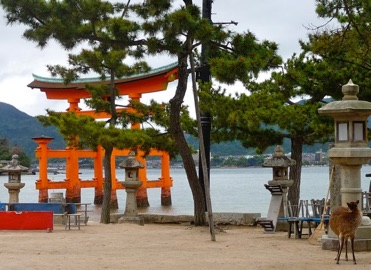
left: The O-Torii Gate in the water and a sacred deer to the right
About a 15 minutes walk from the ferry station, in a bay, is the famous “floating O-Torii Gate”. The gate stands on dry land at low tide, but it usually in the water. The current structure, the eighth since the Heian period, was built in 1875 using wood from camphor trees. The gate is 16 meters tall and the roof is 24 meters wide. The main pillars, made from single trees, are 10 feet in diameter.
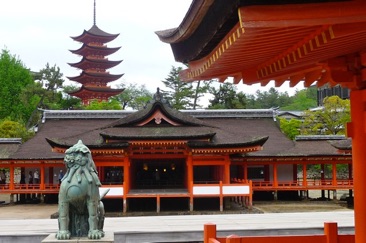
.And facing O-Torii is the breathtakingly beautiful Itsukushima shrine, where the walkways are built on stilts, and where at high tide the whole structure seems to float on the water.
right: Part of the Itsukushima shrine. In the far background is the Senjokaku shrine, constructed by the fabled Japanese warrior Hideyoshi Toyotomi as a place of repose of the war dead. The 5-story pagoda is 80 feet high.
The original shrine was built in 593 AD , but later enlarged to its present size in 1168. The shrine is dedicated to the three Shinto goddesses of the sea, each of whom is believed to live in the shrine. There is considerable engineering involved to ensure that the structure can withstand the pressure of high tidal waves during typhoons. Some of the ancient flooring used were boards 5 feet wide and 30 feet long and came from hundreds of miles away.
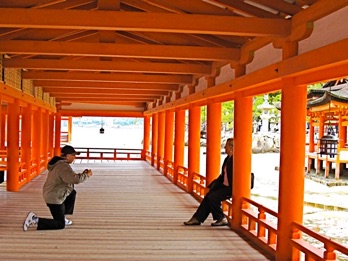
left: Andrew taking a picture of Robyn on a walkway in Itsukushima shrine. As is the case with all shrines, this one is also colored a brilliant vermilion red.
It is not very clear from the pictures, but the areas between the buildings are a few feet below the level of the walkways. The ground is covered with water at high tides.
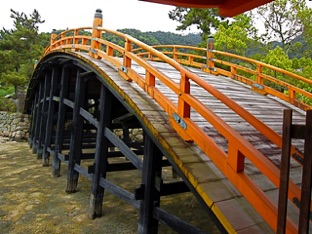
right: the Soribashi or Imperial Envoy’s Bridge. It was used by court nobles sent to Itsukushima Shrine by the emperor to enter the shrine. During this period, steps are temporarily installed on the bridge. The bridge is otherwise closed to traffic.
From behind the shrine we walked up the hill to Fujinotana Park, about a mile away and uphill. It is a serene place to walk and enjoy the surroundings. Amazingly, there were no tourists around. From here Kyoko and Virginia went back, but we pressed on for a few hundred more feet to come to the entrance of the Ropeway, which is a two-stage gondola chairlift to take you up the mountain to obtain gorgeous views of the Inland Sea. 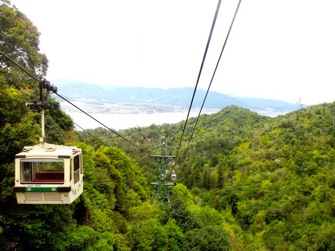
left: From inside the gondolas, there are gorgeous views of the Inland Sea.
The first stage goes up steeply to the intermediate station, Kayatani, which is located at 1100 feet elevation. The second stage of the Ropeway is built over a large gorge with a less steep incline. The end of the ropeway was maybe another 150 feet higher. 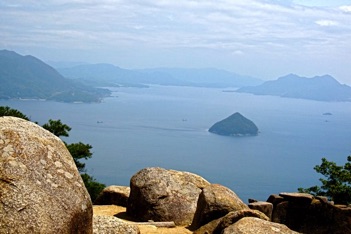 From there you have to walk to get to the top of the mountain, Misen San, at 1739 feet the highest point of the island.
right: View of the Inland Sea.
The weather was incredibly balmy, in the low 70s. We were very lucky. This place, at the end of the Ropeway was, however, not a place for a picnic. There is a café inside, but the resident monkeys would come down and swipe your food and drinks, if you tried to take any edibles outside the building.
Coming down, we took the free Ropeway Shuttle Bus. Surprisingly, it was still a long way down. We had lunch in a small restaurant. They were BBQ-ing oysters on a charcoal grill. We walked down Machiya street, which is the main street of the town, and then down to the Omotesando Shopping Arcade. 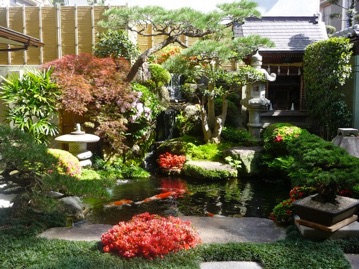 Somewhere along the road was this opulently designed garden.
left: A compact and opulently designed garden for show.
As for the S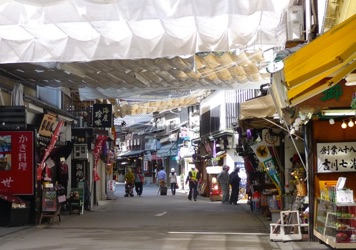 hopping Arcade, there were only a few tourists around. Amazing.
right: the Omotesando shopping arcade.
And so we walked to the ferry station and took a ferry back to the railroad station. From there it was just another 30 minutes before we were back in our hotel.
Touring the Inland Sea
The four main islands in Japan are, from north to south, Hokkaido, Honshu, Shikoku, and Kyushu. Honshu is the biggest and Shikoku is located in a huge bay at the south-western end of this island. The waters between these two islands comprise the Japan Inland Sea.
The next day we took a taxi to get to the center of Hiroshima to get to the central bus station. There we boarded a comfortable long-distance bus going east to Onomichi, about 100 miles east of Hiroshima. The landscape was rugged and there was little traffic. The 2-lane highway was excellent.
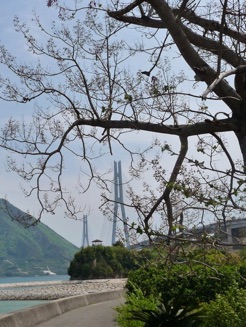
left: The Tatara bridge, open for traffic in 1999.
We crossed 4 bridges. The last one was the Tatara bridge, which has the the world’s second-longest main span of any cable bridge. We were dropped at a completely deserted bus-stop on Omishima Island, located in the middle of nowhere.
Nobody around as far as we could see, not even the ubiquitous tourist. But soon afterwards a taxi pulled up; Kyoko had arranged it, and we were in a moving vehicle again. The ancient emperor Jimmu declared this island the seat of the gods, but civilization has effectively converted an island shrouded in mystery into one which is boringly nondescript. It also encourages the average tourist to skip the island.
Oyamazumi Shrine.
But we did go to visit the Oyamazumi Shinto Shrine, the place where, throughout the centuries, Japanese military leaders prayed for victory in their campaigns. It seemed to have worked many times and the victors have come back and donated their prized weapons and spoils as offerings to the gods. The centuries-old collection in the old and dusty looking martial museum contains, a.o., the only surviving armor of a woman warrior. Of all the ancient weapons and armor, which have been designed as national treasures, some 80 % are housed in the museum belonging to the shrine.
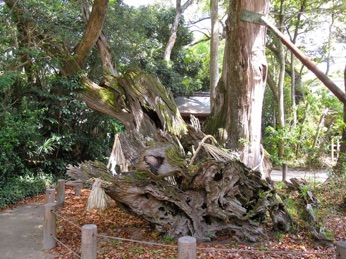
The other attraction is the presence of ancient camphor trees. There was one, 3000 years old and very dead, and another one, about 2600 years old and still alive. I was also surprised to see a California redwood tree.
right: A 2600 year-old camphor tree.
Hirayama Museum of Art
Our taxi drove us back over the Tatara bridge to Ikuchijima Island. Our first destination was the Ikuo Hirayama Museum of Art in Setoda, showing mostly the work of the artist. He was born in 1930, survived the A-bomb in Hiroshima, and is well-known for his drawings of the Silk Road in Iran, Iraq, and China. His other works show the introduction of Buddhism to Japan and his efforts to preserve the cultural heritage of the world.
The Kosanji Temple.
Just a block away from the Museum is the Kosanji Temple, reportedly built by a monk to honor his deceased mother Considering the expenditures required for such an opulent and impressive complex, he must have other resources than just alms for the poor. It turned out that he was a successful business manager of a steel-tube company in Osaka. After her death he became a Buddhist monk. He worked for thirty years on this complex to ensure that she would be reborn in the upper echelons of Paradise.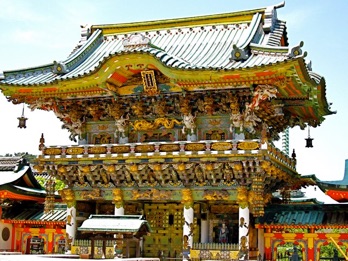
left: The opulently decorated Koyonomon Gate, modeled after the Yomeimon Gate of the Nikko shrine
On the huge temple grounds, which covers about 12 acres, there are Chinese and Japanese style temples, as well as many other structures related to Buddhism. Many of them are “loose” reproductions of other famous temples. 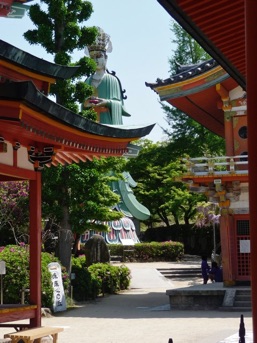 In this fairly huge property, everything has been meticulously crafted and maintained. The result transcends kitsch. It is actually quite appealing.
right: Large statue of the Goddess of Mercy between the buildings.
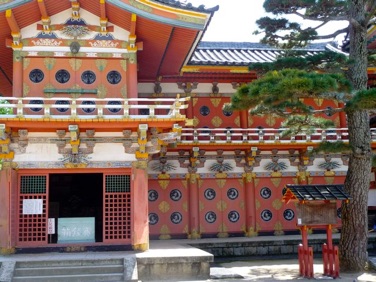
left: One of the minor temples on the temple grounds.
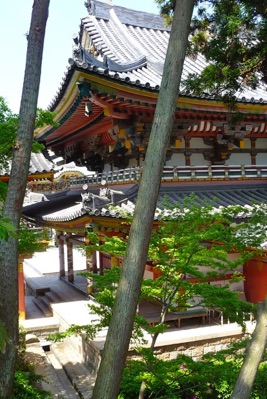
left: Another view of the temple complex.
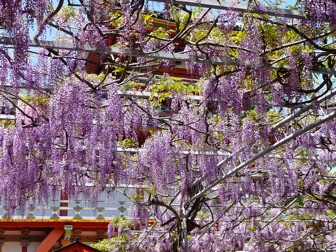
left: The wisteria were in full bloom
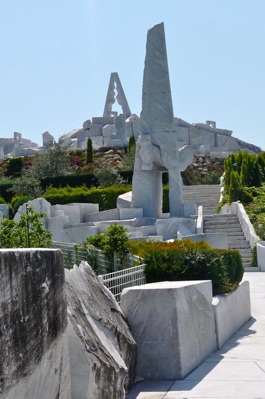
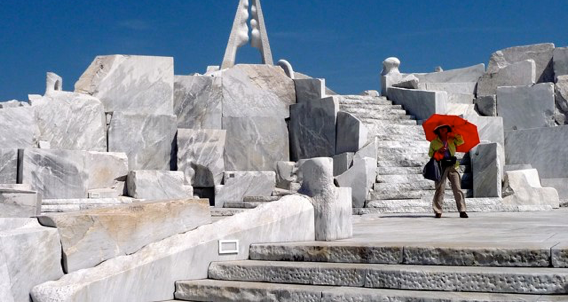
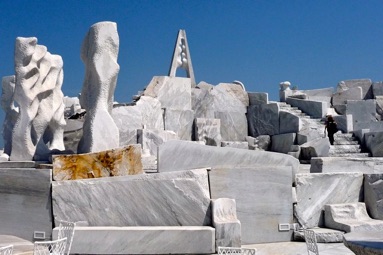
The most amazing thing in the temple complex was actually a marble sculpture garden, built on a one-acre site on the top of a hill. The place is called Miraishin no Oka or, The Heights of Eternal Hope for the Future. There are no marble quarries nearby, so it was obvious they must have transported these heavy stones from somewhere. Well, the stones are Italian marble from Carrara. And the sculptor was Kazuo Kuetani.
right: View of the Miraishin no Oka.
From here we walked through the main shopping street of the town to the harbor. Maybe it was siesta time, but there were few people around. So it doesn’t look like many tourists come here. From the harbor a small ferry boat took us to the port of Mihara, a small town on Honshu, from where a train took us back to Hiroshima.
left: Another view of the sculpture garden
When we stepped in the small forward cabin of the ferry boat, which could seat maybe 30 passengers, there were already a family of 4 sitting on the front row. When we came in, they stood up and offered us their seats, so we could have a better view of the scenery. That was extremely nice of them, but we politely declined and thanked them. It was a small gesture, but it speak volumes of their inherent courtesy towards strangers. Don’t expect this in New York.
In Hiroshima we had our farewell dinner and we asked for a Japanese menu to substitute for the usual standard European fare. We didn’t think we would have been served Kobe beef anyway. The Japanese food was a dazzling array of small dishes of fish, oysters, calamari, tempura, etc. It was good.
Himeji.
Today was our last day in Japan, and since our plane would not leave Osaka until later in the afternoon, Kyoko organized a tour for us to go to Himeji by ourselves. She needed to take Virginia to the airport for an earlier flight.
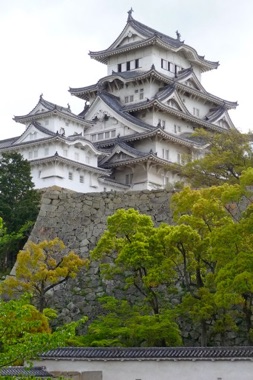
Himeji Castle
From Hiroshima the bullet train took us to Himeji, and a taxi took us to Himeji Castle. The castle was only about 2 miles away, but we saved precious time and energy by not walking this distance. Besides, the taxi fare was only ¥680 for the four of us.
right: Himeji Castle.
This is probably Japan’s most spectacular castle, a typical Japanese Medieval castle of the samurai shogunate period. It is built high up on a hill, strikingly white, surrounded by high outwards sloping battlements, and it is 7 stories high. It is also called the “White Heron Castle”, because it looks like a bird ready for flight. There were three moats to serve as three lines of defenses. Unlike many other castles in Japan, this one has never been seriously damaged or pillaged by wars, earthquakes or fires. At the end of WWII, Himeji was bombed twice, but the castle remained relatively unscathed.
The original fort on the site dates back to the 14th century, but the current castle complex was completed in 1618, when the last major addition, the Western Keep, was completed. It has the distinction of being the first National Cultural Treasure registered by UNESCO as a World Heritage Site, and is now the most visited castle in Japan.
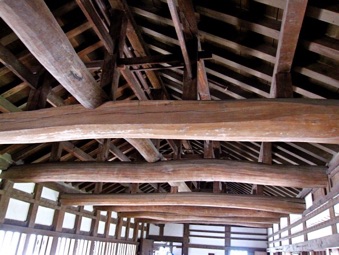
left: Some of the huge beams used in the construction of the castle.
It has been used as backdrop in a number of films, such as in the James Bond film “You Only Live Twice”, “The Last Samurai”, and in the 1980 TV Miniseries “Shogun”.
.
There are many paths going up to the main keep. This is very confusing, because many of them come to dead ends. This has apparently done on purpose to confuse a potential enemy, because they have to travel in a spiral pattern and can be watched from different locations in the castle.
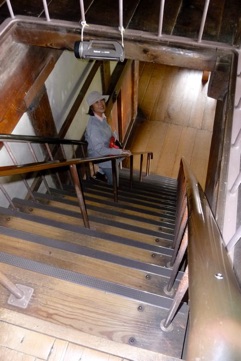
right: Steep stairs connect the different floors of the castle. Ready for an elevator.
There are seven stories in the main castle, with only narrow and steep ladders to go between the floors. On the main floor, I believe it is the fourth floor, were the comfortable living quarters of the lord of the castle and his family. We were amazed to see that there was a flushing toilet. A funnel-like chute made of porcelain with a water tap on the top.
And in the floor below this there were weapons, suggesting that this was where security guards were stationed.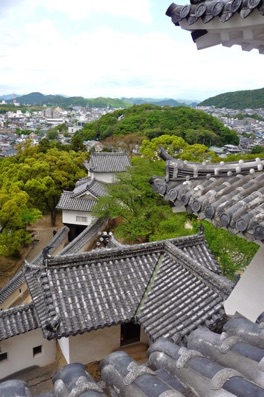
left:: From the top are nice views. Himeji town in the background.
From the top of the castle, there was a nice view of the surroundings and of the interesting roof patterns of the building. And there were of course the usual holes for throwing stones, scalding water, rifles, and arrows to make life of any potential attackers miserable.
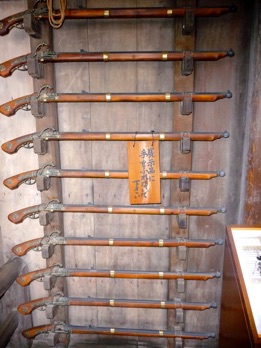
right: A rack of vintage long-barreled flint-lock pistols in the floor for the guards below the floor with the living quarters of the Lord of the Castle.
The Himeji Koko-en Gardens
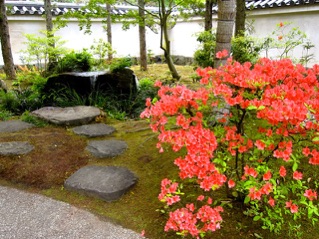
left: Garden at entrance of park. There is a little waterfall coming out of the rock in the background.
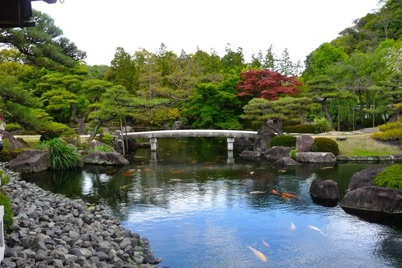
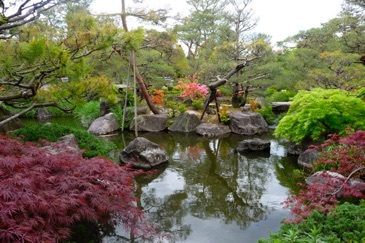
The most splendid garden is Oyashiki-no-niwa, the one attached to the Lord’s House,. There is also a garden with a tea house, a pine tree garden, a bamboo garden, and a flower garden, etc. Everywhere there are flowers, cypresses and other beautifully maintained trees, running water and waterfalls, and goldfish, all very tastefully and artistically displayed.
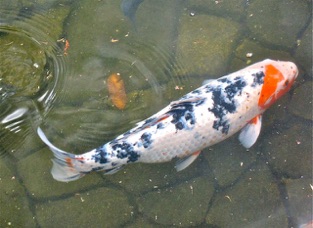
Pictures of the Koko-en Gardens. The one in the middle is the main garden at the Lord’s residence.
We took a taxi back to the station. Had a hasty lunch in the food court, a bowl of rice with 5 shrimp tempuras for ¥550 each, picked up our luggage in storage and caught the Shinkansen to Shin Osaka. Kyoko was waiting for us there and together we took the train to Osaka airport, a huge complex built over water.
There we said goodbye to each other and took our respective planes home. That was the end of a splendid trip.
VI: Hiroshima and the Inland Sea
7/8/09
The Miraishin no Oka Garden, sculpted in Cararra marble in the Kosanji Temple, Ikuchiyima Island.