

We drove to Nanchang, and in the last section on a new highway with speeds up to 120 km/hr; we arrived at our hotel in time for lunch. The Jiangxi hotel was a 4-star hotel and quite opulent. It was actually a converted guesthouse; the original hotel is next to it and not so nice. There is presumably a nice gym in the hotel, but nobody seemed to know where it was.
Nanchang
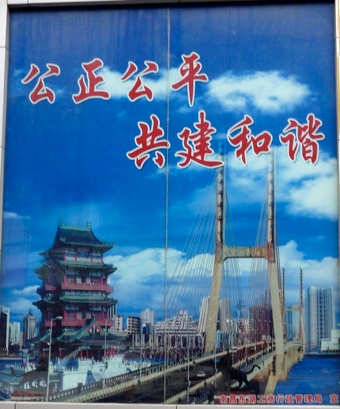
left: poster of Nanchang, 2009. The 1300-year old Teng Wang Ge tower in the back and the modern bridge over the Gan river.
It is a large sprawling city. With a population of just below one million, (close to 4 million in 2009) it cover 65 sq. kms in area. With all the apparently haphazard traffic on the streets, we had not seen an accident before until now where we saw a police car which had rear-ended and damaged another car. At another point we also saw the result of an encounter between a motorcycle and a taxicab with the motorcycle getting the worse of this event.
In the afternoon, in a slight drizzle, our path led us to the Teng Wang Ge tower. This was a large 5-storied watchtower set in a park. The original was built during the Tang and Sung dynasties. It was one of the three most famous watchtowers in the nation. It was unfortunately destroyed by fire, but it was rebuilt in 1989 about a few hundred yards away from the original location with lots of concrete painted over to look like wood.
An elevator took us to the top floor, from where we were able to watch the tail end of the performance of a local opera company. There was a nice view of the Ganjiang river nearby with a modern bridge in the distance. As we walked down floor by floor and looked at all the souvenir stands we could safely assume those were not there in the original version of the tower. Surprisingly, all these stands were owned by the local Government and the prices were fixed. No haggling, so it wasn’t really much fun.
Dinner at hotel and early to bed. It was too cold and windy to walk outside in the evening.
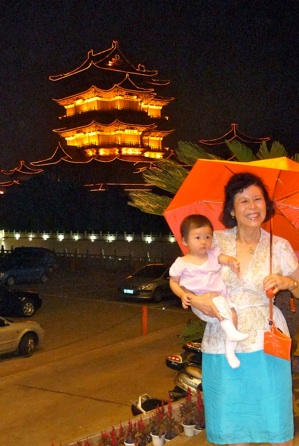
We had the opportunity to visit Nanchang again in the summer of 2009, ten years after we were there earlier. We were there for a week. It was still raining a lot; and if it was not raining, it was awfully hot and humid. The Teng Wang Ge Tower was still there, now nicely lit in the evenings.
right: Norma and Athena with the Teng Wang Ge tower lighted up in the evening.
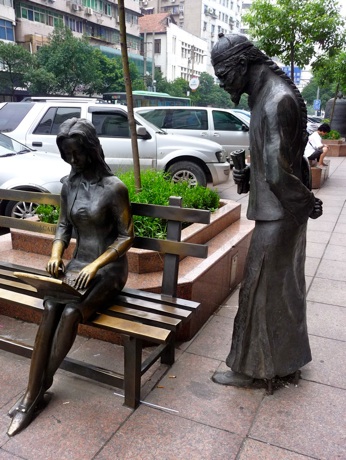
I thought this modern sculpture on the streets of one of the main streets in modern Nanchang was very interesting and apt.
left: An ancient Chinese scholar looks with wonderment at a modern young lady with a laptop.
The Chinese Tea Ceremony
Much has been written about the Japanese Tea Ceremony, but the Chinese also have a highly stylized tea ceremony. Nanjang has the only “Tea University” in all of China. It has an enrollment of around 4000 students, who learn all about tea in general, Chinese teas in particular, and the Chinese tea ceremony above all.The graduates can easily find positions in high-class tea houses and the top graduates travel abroad to give tea ceremony demonstrations.
We went to see a performance in a special tea house. It is something between Chinese opera and Japanese Noh.
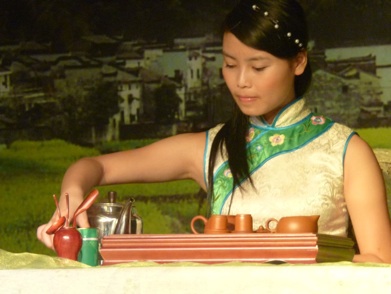
right: One of the top students of the Tea University, a very pretty girl, performing the tea ceremony on stage.
The same ritual, but now much more stylized is then performed on stage by very elegantly dressed, beautiful performers.
Shanghai and the Shanghai Museum.
Left hotel in the morning to go to a small military airport for our flight to Shanghai. Porcelain is everywhere in this region. Along a street we drove by the lampposts had coverings of porcelain. At the airport we said goodbye to Liu tai-tai, Lily's mother. We had really enjoyed her company during the trip. So she and the driver and their load of priceless porcelain left for Nanjing.
From the airport we stopped for lunch and then went to our hotel, the Peace Hotel close to the Bund. We had stayed there during our last trip and we enjoyed its very nice location in the center of the City. The elevated ring road around the city of Shanghai was operational so it took only 30 minutes to get from the airport to the hotel.
In the afternoon we visited the Shanghai Museum, a beautiful and modern 4 story building, certainly worth several visits. The items I remember was a Hezhen national suit made out of salmon skin and a slit ring made out of jade from the Majiabang culture which flourished in 51 - 39 centuries BC !!. There were many artifacts from the Songzhe culture, 39 -31 centuries BC, including fully decorated jade vessels. In the later centuries the interesting artifacts were the pieces of jade put in the mouth of the dead upon burial. The Songzhe culture was followed by the Leangzhu culture (31 - 22 centuries BC), the Hongshan culture (30 centuries BC) and the Shijiahe culture (24 -20 centuries BC). The museum shop was worth a visit and we bought a replica of a painting in the collection of the museum for RMB 620; plum blossoms by Wang Mian, painted in the Yuan dynasty (1279 - 1368 AD).
In the evening we went to Meilongzhan Restaurant for an imperial dinner. We were here last time and just as on the previous occasion the food was marvelous and refined. They have been in business for more than 50 years and their name is derived from the legend of the Ming emperor Zhengde, who used to visit incognito a restaurant in Meilongzhan, a suburb of Shanghai. The bill came to about US$40/per person. Not inexpensive, but we are now in a major Chinese city.
On the next day, a free day, we all went our own merry way. Anneke joined us walking down Nanjing Road looking at some shops and then to the area of the bookstores looking for the Foreign language bookstore. Actually they were not as good as the one in Beijing.
Lunch in the self-service Diamond Cafeteria on the wharf along the Bund, included marvelous shrimp and beer, for RMB 72 for two. Then a few steps further to take a harbor tour on the Whampoa on a 170' catamaran. We chose to go first class for RMB 100 for which we received large plush reserved fauteuils in the forward lounge, nuts and candies, moon cakes, cookies, and unlimited amounts of hot water for our special tea, the hot water being poured out from a big kettle with a long spout.
Met a group of Dutch people on the back deck. This was actually the second class deck and foreigners had to purchase either a first or second class ticket (RMB 80). But their guide insisted on purchasing a lower class ticket for RMB 45 or so, which put them on the lower deck, but they then calmly walked up to the second class deck and stayed there.
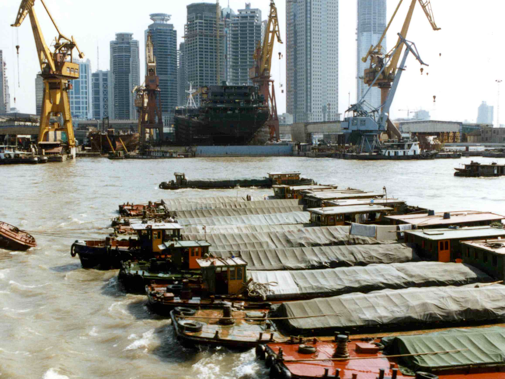
It was one of the most interesting harbor tour we have experienced. The Whampoa is full of different vessels, barges, tugboats, ferries, luxury liners, warships, container ships, tankers, etc. The river mouth is on the Yangtze river and the mouth of the Yangtze is actually close by in the East China Sea. The distance from the berth, about a mile from the hotel, to the end of the river was about 30 kms and there is a large variety of buildings on the shore; luxury apartments, container ports, railroad tracks, even a small refinery. We sailed under the bridge over the Whampoa, the world’s longest suspension bridge with the floor of the bridge some 80 meters above the water level. The middle section of this bridge is 1.2 kms; with the ramps, the bridge is 7 kms long.
The next day the hotel bus took us to the airport, a short 30 minutes drive. We said goodbye to Lily who was taking a bus back to her home. Our planes left within 45 minutes of each other. China Air took us non-stop to San Francisco; 10575 kms in 10 hrs and 20 minutes. Singapore Airlines took the rest of the group to Singapore.