III: Aberdeen National Park
It was 7:30 in the morning when we left for Aberdeen National Park. We heaved a sigh of relief as we left the dust roads of the park for the tarmac of the road. But now we had to deal with the potholes in the damaged deck.
At Nanjuki we stopped at the equator, where an enterprising man showed us the effect of the coriolis force on water in a funnel. In the first demonstration the water would spin clockwise. But walking a hundred yards to the other side of the equator, the water spins counter-clockwise when poured in the same funnel. He was also selling certificates for passing the equator for KS 200 each. Which was a good way of tipping him for the demonstration. Some (quasi)-scientists claim that in this short distance the difference in the coriolis force is so small that the it would have no effect how the water would spin. Well, maybe that is true and the entrepreneur had a little trick to ensure that the test always came out as expected. That is why we tipped him.
Since this is a standard stopping place for tourists, there were also lots of tourist shops. And they have quite large inventories, so I suspect the artifacts are made somewhere else en masse.
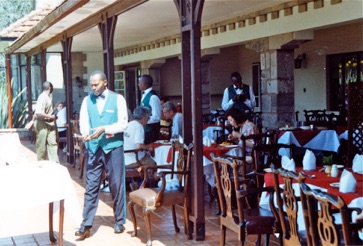
left: Lunch on the verandah of the Outspan Hotel.
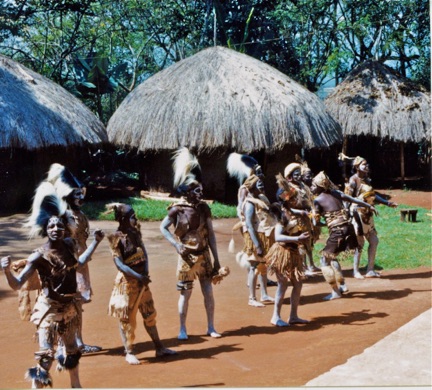
right: Kikuyus in full body paint waiting for tourists for lunch. Their huts are more developed and permanent than those of the Samburu and Masai.
A special bus and driver took us to the famous Treetops Hotel built high up on stilts in and around trees in Aberdeen National Park. The Hotel became especially well-known because Princess Elizabeth was a visitor there in 1952, when her father, king George VI, passed away. She arrived there a Princess, she left a Queen..
The bus stopped in a parking lot some 250 meters away, and the driver then took his rifle out to get us into the appropriate mood. He solemnly warned us that we were embarking on a very dangerous journey and that we had to walk or run from stockade to stockade between the parking lot and the entrance stairwell of the hotel proper. Around some trees were these stockades, which are strong wooden enclosures, with small entrances, where we would find shelter if an elephant or buffalo decided to show us who was the boss.
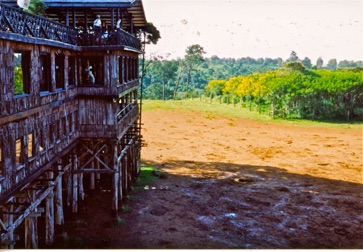
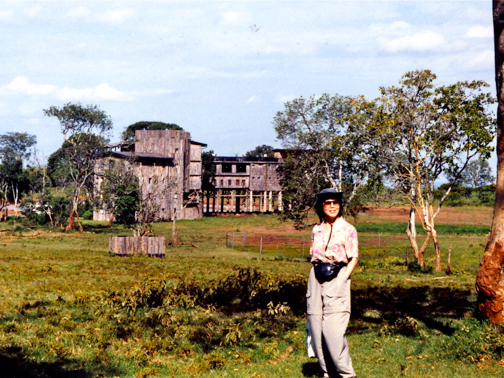
left: The Treetops hotel facing the lake with the salt lick in front.
The hotel was built on stilts with the lower floor about 20’ above the ground, higher than the height of an elephant. There were two more floors above that with fairly small guest rooms. There was no room for suitcases, and we were advised to take no more than an overnight bag along. There were communal bathrooms with showers and hot and cold water. The water was very soft. I made the mistake of lathering myself in soap, and after 10-15 minutes of showering I was still not able to remove the slippery feeling. The very top floor was an open-air viewing platform, partially covered. Adjacent to the hotel is a lake, about 200 m in diameter, as well as a natural salt lick close to the building. Salt is now periodically added to the lick to ensure that the wildlife would keep coming. The salt lick is obviously the attraction for the wildlife, not the hotel. Floodlights were strategically placed to light up the scene.
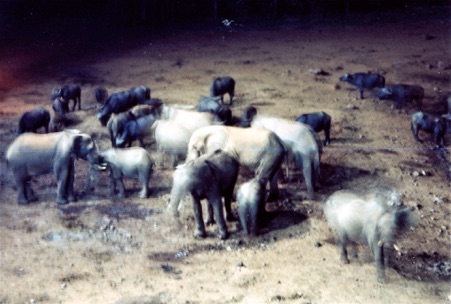
right: Wildlife on the salt lick in front of the hotel at night.
The elephant was king and the other animals deferred to them. There was a steady procession of these behemoths coming from the jungle through an opening in the fence on the back side of the lake to the salt lick and back. It was really an impressive sight.
The Aberdare Game Park.
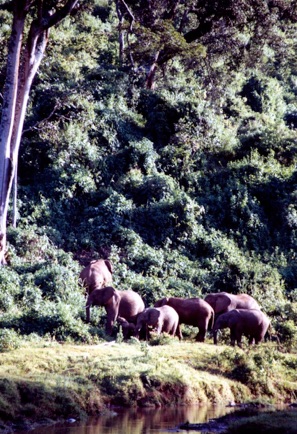
left: Elephants in the park climbing up a steep hill.
At the lodge we had our usual 5-course dinner. We were in danger in getting seriously overweight during this trip. Because of the narrowness of the room, the food was served at the end of the tables and slid by a clever mechanism to the people sitting further away.
In the evening there was an interesting talk by Amos Ndūngū, the resident travel specialist. He was dressed in formal Kikuyu garb, which may not be appropriate for opening night at the Met, but was quite in keeping for these surroundings. Somehow he looked familiar. Yes, he was our driver in the special bus for the park, the man with the rifle. As a driver he looked different in Western garb, but he did deliver a knowledgeable presentation.
People call him a Kikuyu, but his tribe should actually be called the Gikūyūs, where the ū is pronounced like the o in “boy”. He said there are 42 tribes in Kenya, divided in 3 large groups:
a: The Bantu. They are the farmers. The Kikuyus belong to the Bantu group. The Bantus came from the Congo in the 16th century. They are located mostly in the Eastern and Central parts of Kenya.
b: The Nilotic. They are nomads. The Masai and the Samburu belong to the Nilotic group. They come from the Sudan and they are mostly in the Rift Valley and in the Western areas of Kenya.
c: The Kushites. These people came from Somalia and were originally herders of camels and sheep.
When we went to bed we were told that the buzzer in the room would sound if an unusual animal, such as a lion or a black rhino, would appear. But we slept the whole night through. Just as well. We actually had the option of turning the buzzer off.
The next morning we left Treetops at 7:00 a.m. to get back to the Outspan Hotel for an elaborate breakfast. Treetops does not serve breakfasts. There is really not much space in a treehouse. Yes, Amos was the driver again.