
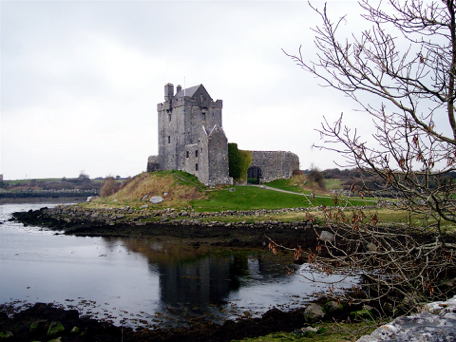
II: Dark and Brooding Castles
Kylemore Abbey.
In a country where the prevailing weather has a tendency to be wet, dark, and brooding, it is obvious that the castles would tend to act the same. We were in Galway on day 1, and in the afternoon we explored the melancholy scenery of Connemara nearby. There the roads are narrow and the shifting light of the dying afternoon accentuates the starkness of the rock-strewn hills and fields in this thinly populated area. In this haunting landscape we drove past little cottages and walls of rocks, which had been painstakingly stacked on top of each other over the centuries.
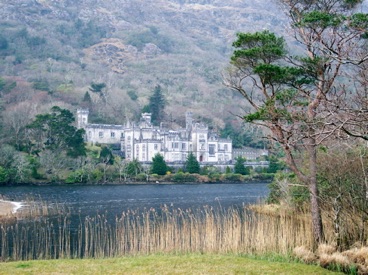
We stopped to look at Kylemore Abbey, a picturesque neo-Gothic style castle, which looked just like what an Irish castle should look like. It was a cheerless-looking citadel, with turrets and battlements right out of the set of Lucia de Lammermoor. In the fading light of dusk, the mood was somber, with the stiff wind blowing little heads of foam on the surface of the lake in front of the castle.
Kylemore Abbey dates back to the middle of the 19th. Century. It was built by Mitchell Henry and it was finished in 1865. He was a successful English financier and his young wife fell in love with the area while on their honeymoon. As befitting the somber mood of the area, she sadly died while on a cruise on the river Nile and only four years after moving into the house. The property was eventually purchased by the Benedictine Sisters of Ypres, after their own convent in Belgium was destroyed in the first world war- they have been here since 1920. It is now one of Ireland's most exclusive girls' boarding schools, catering to Irish as well as to international pupils. Many of the daughters of diplomats and ambassadors have gone through its academic program. From the outside it did not look as if there would be too many wild programs in the curriculum. And if someone you know in the diplomatic service does not have a sense of humor, he or she probably had gone through this program.
There are lots and lots of other castles, abbeys, and cathedrals besides Waterford Castle and Kylemore Abbey. A goodly number of them are in ruins and it seems that a real Irish landscape should look forlorn, dark, and doleful with at least one set of ruins in the picture. Many of the important ruins have been restored and sanitized, so you can visit these ruins and see how some of the structures should have looked like in the original. But many are still maintained as ruins, where the roofs are still gone and not replaced. Sometimes there is a visitor center with toilets and literature describing the castle as it was before. The weeds have been replaced by grassy lawns, the tottering parts of the crumbling walls strengthened, the grime removed from a lot of surfaces, and the newly graveled walking paths have been made easier for the visitor. Some of the castles are only partly in ruins; they still have rooms where you can see exhibitions about the history of the castle and the surrounding areas.
Ballycarberry Castle and Cahergal Fort
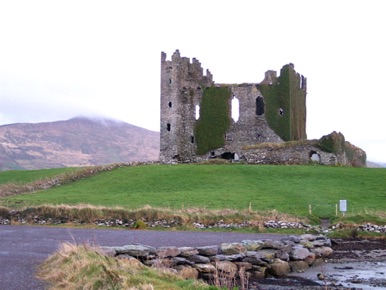
right: The mournful ruins of Bellycarberry Castle
We were there in the waning light of the windswept and cloudy afternoon; there was nobody around, and the ruins of the castle conveyed a feeling somber and haunting. There is moss everywhere on the walls and except for a few pigeons and surely some ghosts, there is nobody there to claim the place as their abode or even as an occasional place to work or while the day. Count Dracula may have lived here for a short while before he was resettled to Transylvania, because even he may have found the castle and the surrounding moors rather too bleak for his taste. Bram Stoker, the author of the novel “Dracula”, published in 1897 to mixed reviews in London, was Irish-born, by the way. Surprisingly, the grass lawn in front of the ruins was green and well-kept.
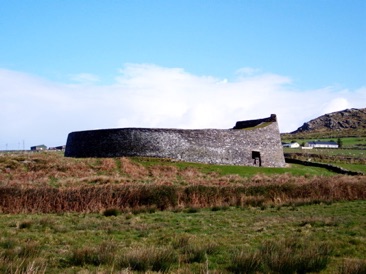
left: Cahergal Fort
1This is a very unusual fortress because it lies close to the ground and is round with no protruding spires and watchtowers. Looks as if the concept is that of a tortoise. Go in a shell and allow the superior fortifications take the brunt of the enemy attack.
Somewhere in this same area are the ruins of another fort, Leacanbuaile, but we could not find it in the waning light.
Kilkenny Castle.
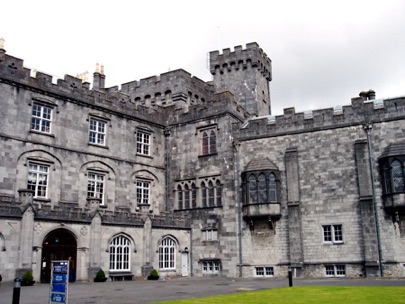
left: Entrance to Kilkenny Castle
The high point of the castle tour is its “Long Gallery”, where both the walls and hammerbeam truss wooden roof were richly decorated, the walls with paintings and gobelins, the wood with finely detailed drawings and decorative art. It took the artist close to three years to finish the drawings on the trusses. The main fireplace was covered with sumptuous white Carrara marble, and sculpted in it was the crest of the Butler family. Their motto was “Comme je trouve”, which sounds rather nonchalant to me. No photography was allowed, but neither did we see any postcards for sale showing this part of the castle.
St. Patrick’s Rock of Cashel.

right: St. Patrick’s Rock of Cashel.
It was the seat of the King of Munster as far back as 360 AD, and it remained a royal fortress until 1100, when king Murtaugh O’Brien granted it to the church.
But behind the forbidding ramparts a lovely cathedral was built. And there are still some very well-tended old graves in the graveyard, reminding the visitor of the temporal nature of life and of the generations who had lived, loved, and toiled here in the past.
Cahir Castle

left: Cahir Castle in County Tipperary.
At one time it was also the stronghold of the O’Neills, who were leading the Irish revolt against the British Crown. The Earl of Sussex, described by the more salacious historians as the most prominent lover of Queen Elizabeth I, was directed by her to quash the rebels. So he went out and managed to capture the castle after just a brief siege, sorely disappointing his enemies in court who was hoping he would stumble in this assignment.. The Irish did not mount much of a defense and the O’Neills managed to escape by climbing down the ramparts in the dark and rowing away in a small boat to fight another day. Queen Elizabeth I, as befitting her imperious majesty, was not too happy with the results. Defeating the enemy and capturing his castle was fine, but letting them escape was in her book inadequate, and it was said that this turn of events resulted in a marked decrease in his assignments to her bedroom chamber.
Jerpoint Abbey
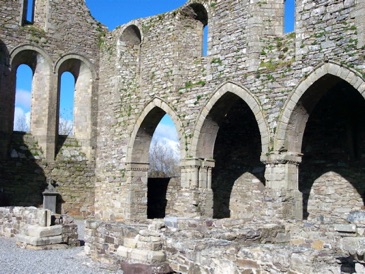
right: The well-preserved ruins of Jerpoint Abbey,

The Abbey is now a national monument in care of the Office of Public Works and legend says that Saint Nicholas is buried here.
left: Stone carvings on a tomb in Jerpoint Abbey.
Muckrock Friary
Muckrock Friary in Killarney National Park we visited on a dreary rainy morning, which actually becometh it well. Weeds and grass were growing between the graves and the building itself had large amounts of moss on the walls. The place, also called Muckrock Abbey, founded in about 1448, has as the central feature a vaulted cloister around a courtyard, which contains a huge Yew tree, traditionally said to be as old as the abbey itself. There were huge stone tombs or sarcophagi on the ground floor of the church dating to the 18th century.

left: The melancholy ruins of Muckrock Friary.
The roofs were gone, but the structure was sound enough for us to climb onto the second and third stories. On the top floor was a section of a wall, which must have been part of the outer ramparts, because it had the narrow vertical slits for archers to launch their missiles protected by the surrounding walls at the enemy outside. And on the top of this 20” thick wall, which was sloping outwards, there was a long trough. There were little gullies leading outwards from this trough.
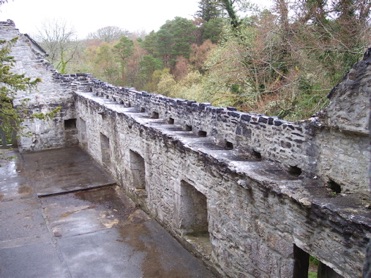
right: This is where hot oil can be poured so the burning liquid will pour out in rivulets over the ramparts on the heads and bodies of any enemy brave enough to scale the walls.
The Muckross House.
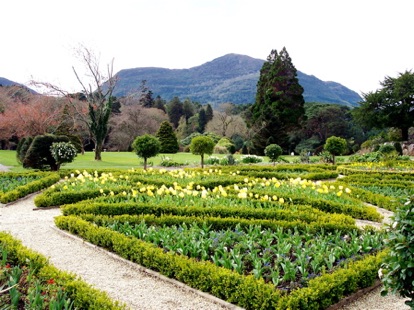
The mansion, with 100+ rooms, was given to the Irish Government in 1932, because the owners could not afford to maintain it anymore. The Government made it a tourist attraction to pay for its keep.
left: Part of the extensive gardens of the Muckross House.
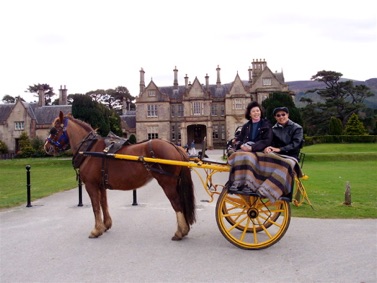
To view the grounds in more comfort, visitors go on a “jaunting cart”, which is an open horse-driven cart. The official route takes you from the mansion to the Torc Waterfalls and back, with a short detour to view the lake. All this for €30 for a trip covering about 5 miles. You can also walk this route if you feel like it.
right: A jaunting cart with Muckross House in the background. Passengers sit next to each other facing sideways.